PE
Practical engineering
Start with the real facility, real constraints and the route treatment must follow.

The Zoonex story
The Zoonex journey began with practical experimentation during the pandemic and a shared belief that cleaner air should be achievable through better dispersal and delivery.
2020 — The starting point
Under a freestanding roof in Tim Jonck’s back garden, early prototypes used available equipment — boilers, pressure vessels and high-pressure fogging systems — to explore how liquid antimicrobial chemistry could become a practical protective mist.
Each attempt revealed more about droplet behaviour, consistency and the challenge of reaching surfaces and air pathways evenly.
The turning point
Tim’s son, Alexander Jonck, proposed a different dispersal approach. The idea produced a finer, more consistent mist and became the catalyst for a new phase of testing and refinement.
Practical engineering begins by observing what is not working — and being willing to try a different route.
From experiment to platform
Available equipment was adapted to investigate how antimicrobial chemistry could be converted into a usable mist.
Alexander’s alternative approach helped create the consistency needed to progress the concept.
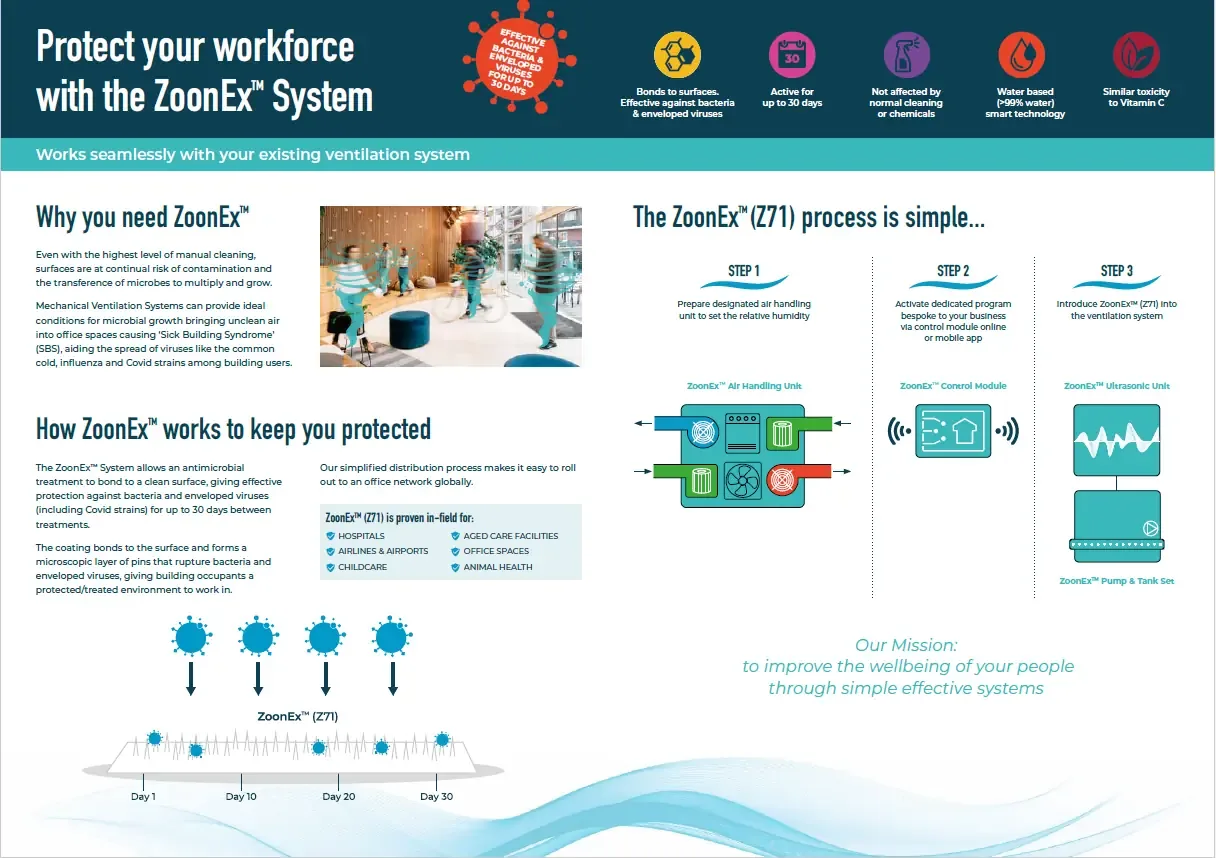
Multiple configurations were tested to improve delivery, coverage and practical integration with ventilation pathways.
The search expanded internationally to identify equipment and system components suited to demanding implementation requirements.
The original idea now supports site-specific programmes across healthcare, commercial, hospitality and biosecurity environments.
What still guides the work
Start with the real facility, real constraints and the route treatment must follow.
Keep every claim tied to the correct evidence, method and application scope.
Build a managed programme rather than treating the project as a single isolated event.
The next Zoonex programme begins with a practical problem, a site review and a better treatment route.