
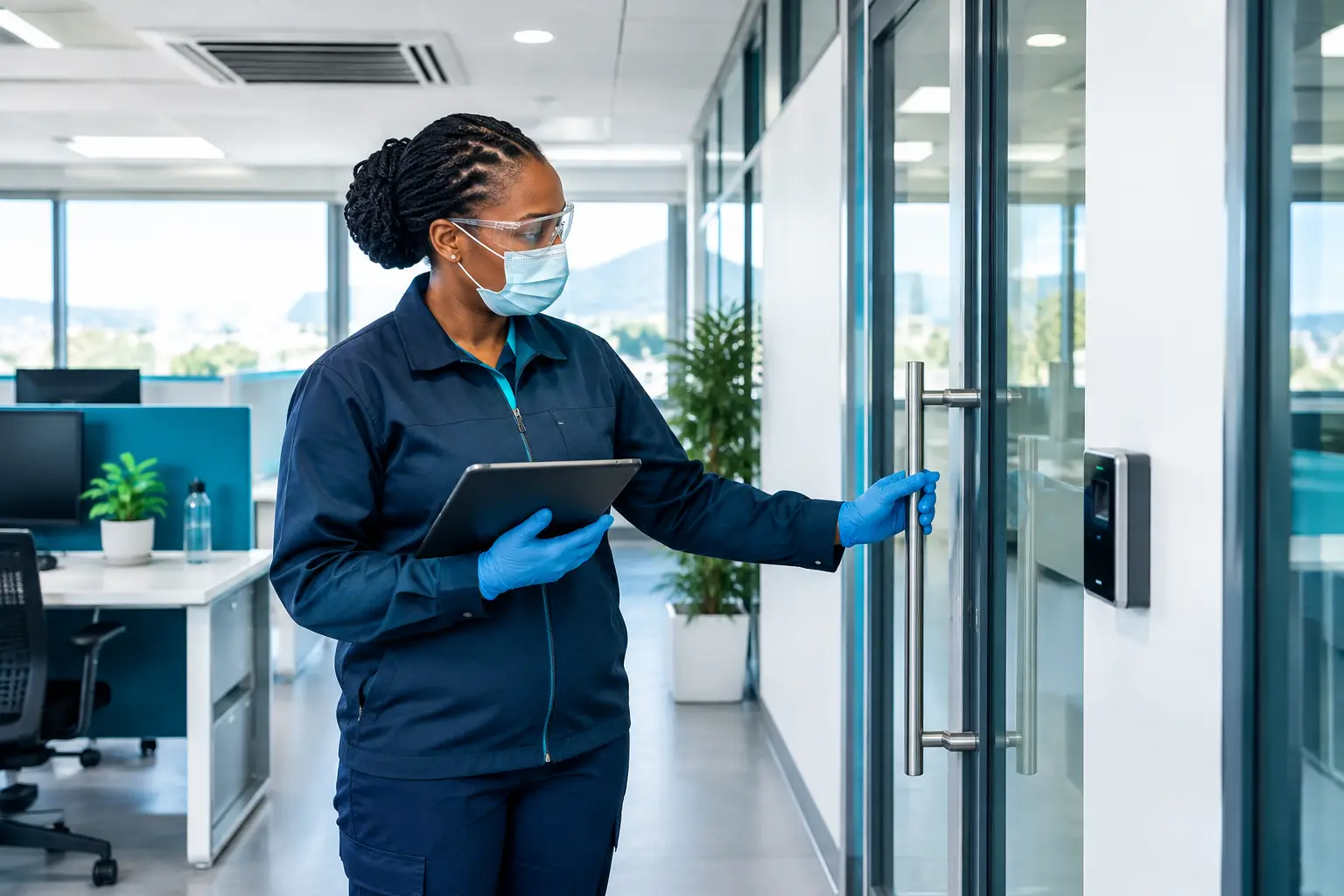
A reception desk may be cleaned several times a day, yet the same facility can retain unmanaged contamination risk through shared equipment, ventilation routes, high-traffic zones and operational pinch points. The best contamination control measures do not treat these as separate cleaning tasks. They treat them as connected pathways within a working building.
For facilities managers, infection-prevention teams and operations leaders, the objective is practical: reduce avoidable contamination transfer while keeping people, equipment and services moving. That requires more than a once-off response. It calls for protection that moves through the building in ways that reflect its layout, occupancy, airflow and daily pressures.
Why contamination control must follow the facility
Contamination does not remain neatly on the surface where it first appears. People carry it between zones on hands, footwear, uniforms, trolleys, tools and shared devices. Air movement can carry particles through supply and return routes. Doors, lifts, washrooms, staff areas and service corridors connect spaces that may look separate on a floor plan.
Routine cleaning and disinfection remain essential controls, but their timing and reach are naturally limited by access, labour, operating hours and the surfaces that can realistically be addressed. A contamination control programme should strengthen those routines, not attempt to replace them.
The right approach also depends on the environment. A healthcare waiting area, hotel kitchen pass, aircraft cabin turnaround zone, agricultural change room and office lift lobby each have different touch patterns, materials, airflow conditions and constraints. Applying the same treatment sequence to all of them may be convenient, but it is not necessarily proportionate to the risk.
The best contamination control measures work as one system
Effective programmes combine several controls, each assigned to the pathway it can influence. Cleaning removes visible soil and supports surface readiness. Approved disinfection procedures address defined cleaning events. Hand hygiene, waste handling, zoning and staff protocols reduce transfer between people and areas. Ventilation maintenance supports intended air movement and equipment performance.
Engineered antimicrobial treatment can add a further layer when it is selected and deployed for the relevant surfaces, treatment zones and ventilation pathways. The value lies in the design of the system: where treatment is applied, how it is dispersed, how occupied areas are managed, and how the programme is maintained over time.
This is why a generic checklist has limits. It may confirm that tasks have been completed, but it does not show whether those tasks match the physical routes through which contamination is most likely to move.
1. Assess the building as an operating environment
Assessment is the first control measure because it prevents effort being directed at the wrong places. A useful site assessment reviews how people, air, goods and equipment move through the facility. It should identify high-contact surfaces, shared assets, congested areas, ventilation supply and return points, cleaning access limitations and times when treatment can occur without interrupting essential operations.
For example, a commercial property may need attention around lift controls, reception counters, shared meeting rooms and HVAC access points. In a hospitality environment, the treatment plan may also account for room turnover, back-of-house traffic, luggage handling and guest-facing schedules. Agricultural and biosecurity settings may require closer consideration of vehicle movement, change areas, staff transitions and equipment routes.
The assessment should also establish boundaries. Sensitive surfaces, active work areas, food-handling processes, critical equipment and occupied spaces may require specific procedures, exclusions or timing controls. Good contamination management is disciplined partly because it recognises where not to apply a treatment.
2. Disperse treatment with controlled application
Where a treatment method is appropriate, controlled application matters as much as the treatment itself. Ultra-low-volume fogging, for instance, may help distribute a fine treatment mist through an identified space, but it is not a substitute for cleaning or a licence to treat every room in the same way.
The area must be prepared, application parameters must match the environment, and access must be managed in line with the applicable product documentation and site procedures. Occupancy, ventilation settings, surface types and the purpose of the room all affect the application plan.
A controlled process avoids two common failures: applying too little to reach the intended area, or applying without sufficient regard for operating constraints. Professional deployment is not simply about equipment. It is about using the right method within a defined treatment zone.
3. Distribute protection through relevant pathways
Surface touchpoints are visible and familiar, but contamination control should also consider the pathways around them. Air-handling and ventilation routes can connect areas across a facility. Shared controls, handrails, doors, workstations, vehicle interiors and mobile equipment can connect users across a shift.
A systems-led programme therefore considers treatment across multiple protection pathways. This can include targeted antimicrobial surface application on relevant high-touch zones, treatment of defined ventilation-pathway components where suitable, and planned treatment of operational spaces or fleet environments.
Distribution does not mean treating everything indiscriminately. It means choosing the points where movement, touch frequency and operational exposure justify attention. In a busy airport or transport setting, shared seating zones, service counters and crew or staff transition areas may warrant a different focus from storage rooms with limited access. In a hospital, the sequence may need to fit clinical workflows, environmental services routines and restricted-area controls.
4. Maintain the programme, not just the event
Contamination pressure changes with occupancy, weather, maintenance work, seasonal demand, visitor volumes and changes to how a building is used. A once-off treatment may have a place after a specific operational event, but it cannot by itself manage an environment that changes every day.
Managed maintenance routines create the feedback loop. They set treatment intervals according to site conditions, document completed work, revisit high-risk zones and adapt the scope as layouts, usage patterns or operational requirements change. Records also help facilities teams coordinate cleaning contractors, maintenance personnel, safety officers and departmental managers around one plan.
For multi-site organisations, consistency matters. The programme should provide a common method while allowing each location to retain its own assessed priorities. A warehouse, head office and regional service centre may share reporting standards without receiving identical treatment schedules.
Design controls around continuity of operations
The most technically sound proposal is of little use if it conflicts with patient flow, guest service, production schedules or aircraft turnaround windows. Contamination control measures must fit the real working day.
This means planning treatment at suitable times, defining access controls, coordinating with cleaning and engineering teams, and communicating clearly with those who operate the space. A programme designed around the environment, not a generic checklist, is more likely to be followed because it acknowledges operational pressure rather than adding avoidable disruption.
There are trade-offs. A broader treatment scope may require more access time. Treating during quieter periods may protect continuity but extend the programme timeline. High-occupancy sites may need phased work by zone instead of a single building-wide intervention. These are planning decisions, not weaknesses, and they should be made before work begins.
Documentation keeps claims and decisions accountable
Facility leaders should expect a clear record of the assessed areas, treatment approach, application conditions, operational exclusions and maintenance plan. This supports internal governance and makes it easier to explain why specific zones receive priority.
Technical claims should always be read alongside applicable product documentation, instructions for use and the scope of any relevant testing. Performance can depend on the surface, soil load, application method, environmental conditions and whether routine cleaning and maintenance controls continue as intended. Responsible hygiene planning is specific about these limits.
For South African facilities operating across varied climates, building types and service demands, local site assessment is particularly valuable. It allows the programme to account for the practical realities of each environment rather than relying on assumptions carried over from another facility.
The most useful question is not, “What is the strongest single treatment?” It is, “Where does contamination move here, and which controls will remain workable after the team leaves?” That question leads to a programme with a better chance of supporting the people who rely on the facility every day.
