
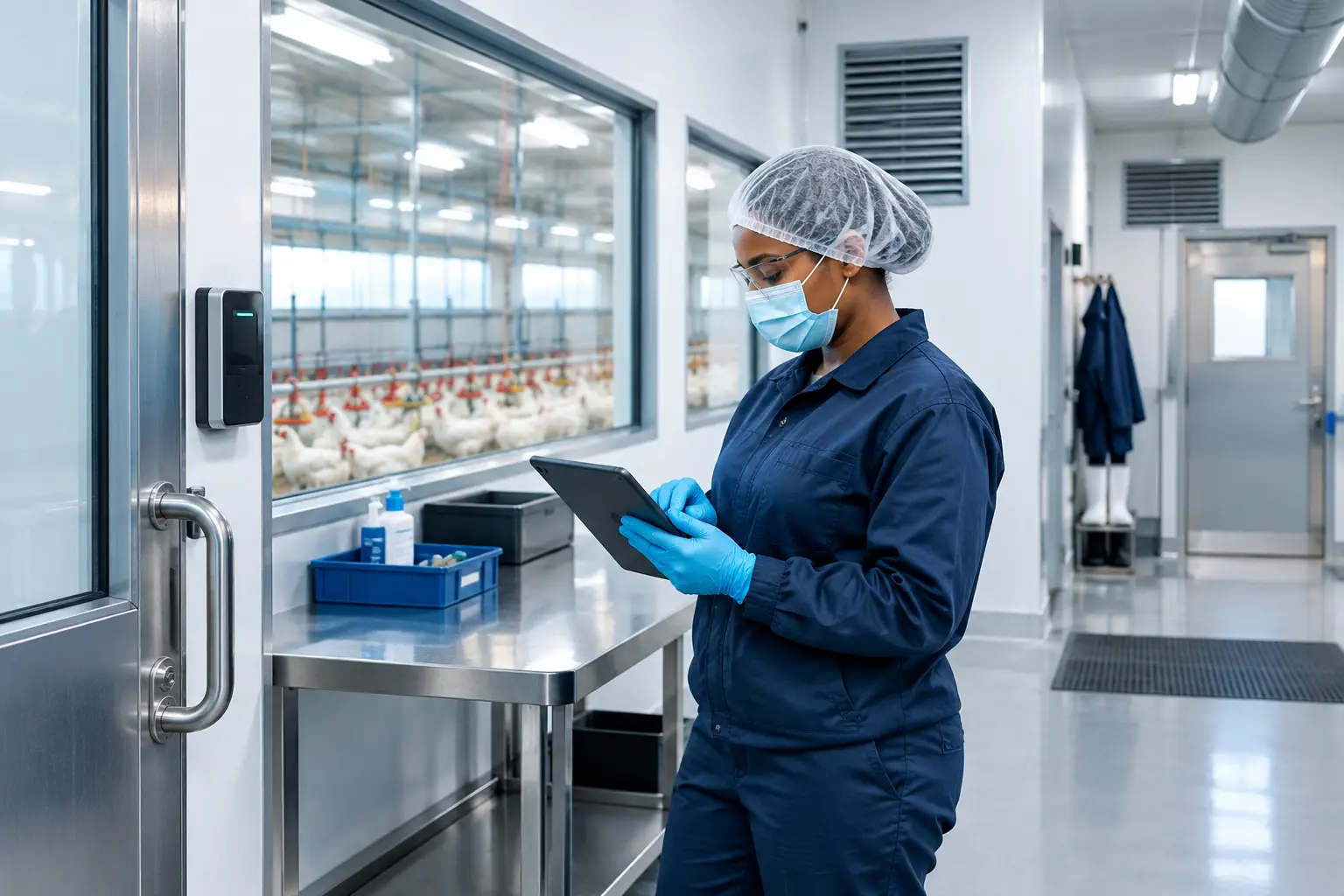
A poultry house can look clean at the start of a shift and still carry avoidable hygiene risk through the systems people use all day. Air moves between zones, staff handle controls and tools, crates travel between areas, and equipment creates surfaces that routine cleaning may not reach consistently. Effective South African poultry hygiene therefore depends on how the whole operating environment functions, not simply on how often it is cleaned.
For farm owners and operational managers, the aim is practical: maintain a controlled environment that supports biosecurity routines, protects operational continuity and fits the realities of a working poultry site. This calls for a planned approach to surfaces, airflow pathways, vehicle movements, people flows and maintenance intervals.
Why poultry hygiene is a systems question
Poultry operations have a high density of activity within a confined environment. Houses, egg-handling areas, staff facilities, storage spaces, loading points and vehicles each have different exposure patterns. A treatment plan that applies the same method everywhere can overlook the routes through which contamination may be carried or redistributed.
Airflow is one of those routes. Ventilation is essential to poultry-house operation, yet fans, inlets, ducts and air movement can also influence where airborne particles settle. The concern is not solved by treating a visible surface once. It requires an understanding of where air enters, where it circulates, where it exits and which surfaces or zones receive the greatest operational contact.
The same principle applies to movement. Boots, wheeled equipment, handling tools, doors, control panels and vehicle cabs connect areas that may have different hygiene requirements. Routine cleaning remains fundamental, but a programme designed around these transfer points gives managers a clearer basis for prioritising treatment and maintenance.
This is why poultry hygiene should be considered alongside daily production planning, ventilation management, access control and cleaning schedules. It is not a separate task added after operations. It is part of the operating system.
South African poultry hygiene must fit local operating conditions
There is no single poultry-site template that works across South Africa. Environmental conditions, building age, ventilation design, flock cycle, staffing patterns and water availability can differ sharply between operations. A naturally ventilated house has different treatment constraints from a mechanically ventilated site. A broiler operation has a different movement pattern from an egg-packing facility or breeder farm.
Seasonal conditions also matter. Heat, dust, changing humidity and increased ventilation demand can alter how air moves through a facility and how frequently certain zones need attention. These are operational variables, not reasons to abandon a hygiene plan. They are reasons to design one around the actual environment.
The practical question is not, “What is the strongest product?” It is, “How can treatment be applied in the right place, at the right interval, without creating unnecessary disruption to people, equipment or production?” The answer depends on a site assessment and on the approved use parameters for the selected treatment.
Start with an assessment, not a generic checklist
A disciplined programme begins by mapping the facility. This involves identifying physical zones, operational routes and the conditions that shape exposure. High-contact areas may be obvious, such as entry points, handrails, wash stations and equipment controls. Other priorities may be less visible, including ventilation components, service corridors, loading areas and the interiors of regularly used vehicles.
An assessment should consider how staff, contractors, birds, materials and equipment move through the site. It should also account for restricted areas, cleaning windows, sensitive equipment, safety requirements and production activities that cannot be interrupted. These constraints are not obstacles to hygiene planning. They define the programme that can work reliably.
For example, a treatment approach for a hatchery-adjacent space may need tighter timing and access controls than one for an administration block. A vehicle used between multiple operational zones may require its own defined process. The point is to match the method to the environment rather than applying a generic checklist across unrelated spaces.
A four-stage approach to engineered protection
For hygiene-critical facilities, an effective managed programme can be structured around four connected stages: assess, disperse, distribute and maintain. Each stage supports the next.
Assess the environment
The assessment establishes the treatment map. It identifies airflow pathways, high-traffic zones, shared surfaces, equipment, vehicle use and operational constraints. It also clarifies where conventional cleaning is already effective and where additional, professionally controlled antimicrobial treatment may add value within the broader hygiene plan.
This stage prevents the common mistake of treating only what is easy to see or reach. It also helps managers document why particular areas receive different treatment frequencies or methods.
Disperse treatment with control
Where ULV fogging is appropriate for the selected product and site conditions, it can disperse treatment as a fine mist through designated spaces. This is a professional application process, not a shortcut for routine cleaning or a substitute for manual surface preparation.
Application must be planned around occupancy, ventilation settings, dwell requirements, access restrictions and manufacturer documentation. A poorly timed fogging event may disrupt operations or fail to reach its intended treatment zone effectively. Controlled deployment is what makes the difference.
Distribute through relevant pathways
Protection should move through the building in ways that reflect the facility’s physical systems. That may include targeted application to high-contact surfaces, treatment of appropriate ventilation-pathway components and managed attention to shared operational equipment.
The objective is one system, multiple protection pathways. Rather than treating airflow, touchpoints and vehicles as isolated issues, the programme considers how they interact during normal work. In a poultry environment, that joined-up view can be more useful than increasing the number of disconnected cleaning tasks.
Maintain the programme
A once-off application has limited management value if site conditions, access patterns or operational pressure change over time. Maintenance creates the discipline of review, repeat treatment where appropriate and adaptation when the facility changes.
Records can support this process by confirming treatment dates, zones, methods and operational observations. They also give facilities teams a practical basis for coordinating contractors, reviewing procedures and planning around flock cycles or maintenance shutdowns. The right interval depends on the environment, the treatment scope and documented product guidance, rather than a blanket promise of duration.
Where treatment priorities commonly emerge
The highest priorities vary by site, but several areas regularly warrant closer operational attention. Entry and transition points matter because they connect staff facilities, production areas and external activity. Shared equipment matters because it passes between people and zones. Loading areas and vehicle cabs matter because they connect the site to external routes.
Ventilation-related areas also deserve consideration, particularly where dust accumulation, service access and air movement influence the wider building environment. This does not mean every component should receive the same treatment. It means the ventilation system should be included in the hygiene conversation, alongside scheduled mechanical maintenance and cleaning.
Packing, storage and administration areas may have lower exposure than poultry houses, but they still contain shared touchpoints and regular occupancy. A site-wide programme should define these spaces according to their actual use rather than assuming that only production areas require structured hygiene controls.
Keep hygiene controls complementary
Antimicrobial treatment is one layer within a wider operational framework. It does not replace routine cleaning, approved disinfection procedures, hand hygiene, biosecurity protocols, pest management, ventilation maintenance or staff training. Each control addresses a different part of the risk picture.
This distinction matters when budgets and labour are under pressure. Reducing a programme to a single intervention can create gaps elsewhere. A better approach is to use treatment strategically: support the existing hygiene system, focus attention on physical pathways and retain the daily disciplines that keep a poultry operation orderly.
Technical claims should always be read with the applicable product documentation, approved directions for use and relevant test scope. Site suitability, surface compatibility and operational controls must be confirmed before deployment, particularly around specialised equipment and production-sensitive areas.
Make continuity part of the hygiene plan
The strongest hygiene programmes are designed to be workable on an ordinary busy day. They account for shift changes, collection times, maintenance access, contractor movement and the limited windows available for treatment. They also avoid placing unnecessary administrative burden on farm teams who already have defined production responsibilities.
Zoonex Systems approaches this challenge as an engineering and programme-management task: assess the environment, select controlled application pathways and maintain the plan as the site evolves. The value lies not in a dramatic one-day intervention, but in a process that can be repeated, documented and managed with operational discipline.
For poultry facilities, the next useful step is to walk the site with a systems lens. Follow the air, follow the people, follow the equipment and identify where those pathways meet. That is where a more resilient hygiene programme begins.
