
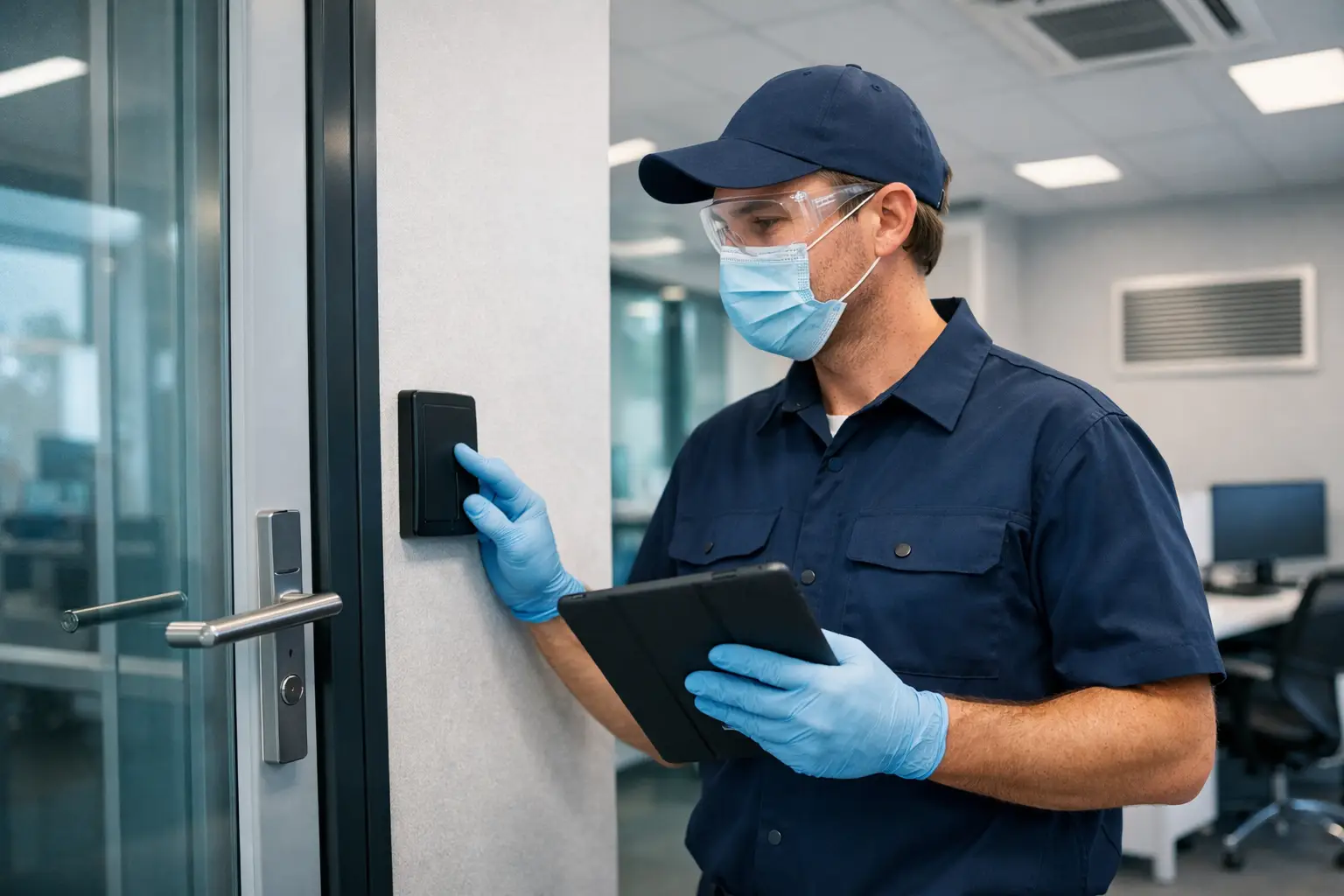
A busy facility is not protected by what happens only at the cleaning cupboard. Environmental hygiene risks are influenced by the movement of people and equipment, repeated contact with shared surfaces and, where relevant, the way airflow connects different areas of a building.
A professional ultra-low-volume, or ULV, fogging service may support controlled antimicrobial treatment across defined, unoccupied treatment zones where the approved product documentation expressly permits that application method.
For commercial buildings, hospitality venues, fleet operations, agricultural sites, aviation environments and other operational facilities, the value lies not simply in the fogging equipment. It lies in determining whether ULV application is appropriate, which areas may be treated, what conditions affect distribution and how the work complements routine cleaning, disinfection, ventilation maintenance and established operational controls.
What a ULV fogging service does
ULV means ultra-low volume. The process uses specialist equipment to produce a fine mist from an antimicrobial formulation approved for the intended application method and treatment environment.
The purpose is controlled application within clearly defined treatment zones, following the applicable product instructions, application rate, contact conditions and safety precautions.
Actual distribution depends on several factors, including:
• The equipment and application settings • Room geometry and ceiling height • Furnishings, shelving and partitions • Airflow and active ventilation • Surface characteristics • Temperature and environmental conditions • The operating requirements of the facility
A visible mist does not prove that every surface has received the required treatment. ULV application should not be described as automatically disinfecting the air, reaching every concealed surface or treating areas beyond the agreed application scope.
ULV fogging may be considered where the approved product documentation permits it and a professional site assessment confirms that it is suitable for the environment. It does not replace cleaning of visibly soiled surfaces, targeted surface disinfection, hand hygiene, ventilation maintenance or other required infection-prevention controls.
Why facility design changes the treatment plan
A generic fogging schedule assumes that every building behaves in the same way. In practice, environmental hygiene requirements are shaped by the physical layout, occupancy and operation of the facility.
A reception area with constant visitor movement has different requirements from a warehouse, poultry facility, aircraft turnaround area, hotel room or commercial vehicle.
Airflow also matters. Open doors, supply and extract vents, ceiling height, pressure relationships and active HVAC operation can influence how a treatment mist moves through a space. Sensitive equipment, food-service activity, occupied areas and restricted-access rooms may also determine when treatment can take place and whether ULV fogging is the appropriate application method.
This is why an engineered programme begins with the site rather than the equipment.
The question is not simply:
Where can we fog?
The correct questions are:
Which surfaces, zones and operational pathways require treatment? Is ULV application suitable for those areas? How can the work be carried out responsibly without disrupting essential operations?
Coverage is not the same as visibility
A visible mist can create an impression of thorough treatment, but visual density alone does not demonstrate correct application or suitable coverage.
Controlled deployment requires consideration of:
• The approved application rate • Product contact conditions • Surface compatibility • Treatment boundaries • Room configuration • Ventilation instructions • Sensitive equipment and materials • Access restrictions • Post-treatment and safe re-entry requirements
Overapplication can be as operationally problematic as insufficient application, particularly where electronic equipment, specialist materials, food-service operations or sensitive assets are present.
Professional deployment therefore requires defined treatment zones, documented procedures and product-specific instructions. Facilities should understand the required preparation, access controls, ventilation arrangements and post-treatment checks before the work begins.
The four-stage approach: assess, disperse, distribute and maintain
An effective ULV fogging service follows a structured process that can be adapted to the environment.
At Zoonex Systems, this systems-led approach connects the treatment method to the physical and operational pathways that influence hygiene risk.
Assess
Assessment establishes the operational reality of the site.
This may include:
• The approved application rate • Product contact conditions • Surface compatibility • Treatment boundaries • Room configuration • Ventilation instructions • Sensitive equipment and materials • Access restrictions • Post-treatment and safe re-entry requirements
For a healthcare facility, the assessment may distinguish patient-facing circulation areas from back-of-house spaces, technical rooms and restricted clinical environments.
In hospitality, the focus may include room turnover, reception touchpoints, dining spaces, service corridors and staff facilities.
For a fleet or aviation operator, the assessment may consider vehicle interiors, passenger-facing areas, turnaround windows and the practical requirement to return assets to service on schedule.
The assessment also determines where ULV fogging may be appropriate and where another treatment pathway may be more suitable. Some areas may require targeted antimicrobial surface application, while ventilation pathways may require a separate engineering and maintenance scope.
Disperse
Dispersal is the controlled production and application of the treatment mist using suitable equipment and approved operating settings.
The objective is consistent application within the planned treatment zone, not indiscriminate release throughout every available space.
Operational timing is central to this stage. Treatment may need to be scheduled:
• Between shifts • During room closures • Between guest stays • During planned maintenance • In sections while the remainder of the facility continues operating • Around vehicle or aircraft turnaround requirements
Where a facility cannot stop operating completely, the programme must be designed around zones, access routes and operational priorities.
Clear communication with the site team prevents avoidable disruption. Staff should understand which areas will be treated, when access will be restricted and what housekeeping, ventilation or operational checks are required afterwards in accordance with the applicable product documentation.
Distribute
Distribution considers how the treatment mist moves through the physical environment.
Room geometry, shelving, furnishings, partitions, doors and airflow can all affect the practical reach of a ULV application. This is why equipment settings and treatment plans must be based on the actual site rather than a generic room-size calculation alone.
A facility may require several complementary protection pathways.
ULV fogging may be appropriate for selected rooms and operational spaces, while targeted antimicrobial surface application may be used for agreed high-touch zones.
Ventilation conditions should also be assessed because active supply and extract systems may affect treatment boundaries, application planning, ventilation requirements and safe re-entry.
This does not mean ULV fogging should automatically be introduced into ductwork or presented as air disinfection. Any proposed ventilation-pathway treatment requires a separate engineering scope supported by the applicable product documentation, HVAC requirements and facility conditions.
The correct balance depends on the environment. A large open warehouse may require a different zonal strategy from a dense office floor, hotel, vehicle fleet or aviation facility. The treatment plan should reflect those differences rather than forcing the same method into every setting.
Maintain
A once-off treatment may be appropriate following a specific operational requirement, but it does not create an ongoing hygiene programme by itself.
Facilities change continuously. Occupancy rises and falls, layouts change, maintenance work takes place, equipment is introduced and new high-use areas emerge.
A managed maintenance programme allows treatment zones, application methods and review intervals to be reconsidered as these conditions change.
Documentation may include:
• Treatment dates and locations • Areas included and excluded • Products and application methods used • Site observations • Access and operational arrangements • Maintenance recommendations • Programme adjustments • Planned review or reapplication requirements
These records support accountability and give facilities managers a clearer basis for coordinating work across cleaning teams, maintenance providers, infection-prevention personnel and internal operational stakeholders.
Where ULV fogging may add practical value
ULV fogging may offer practical value in environments with repeated movement, shared assets or layouts that are difficult to address consistently through manual application alone, provided that the product and treatment environment support this use.
In a commercial office, potential treatment zones may include meeting rooms, reception areas, lift lobbies, staff facilities and shared workspaces.
In hospitality, ULV treatment may form part of planned work in guest areas, back-of-house spaces, service corridors and other high-turnover operational zones.
In agricultural and biosecurity environments, the emphasis may fall on controlled-access areas, equipment zones, vehicle interfaces and operational buildings, subject to the site requirements and approved product scope.
For transport and fleet operations, treatment planning may consider vehicle interiors, depots, crew areas and passenger-facing spaces while preserving operational turnaround requirements.
The suitability of each area must be assessed individually. Treatment should not be applied directly to people, animals, food, sensitive equipment or occupied spaces unless the approved product documentation expressly permits that use and all required controls are in place.
Healthcare and care environments
Healthcare and care environments require a separate level of governance.
Any proposed ULV application must be reviewed against:
• The facility’s infection-prevention policies • Occupational health and safety requirements • Clinical workflows • Approved product documentation • Permitted treatment areas • Material compatibility • Sensitive medical equipment • Access controls and safe re-entry requirements
Treatment must be coordinated with the facility’s established environmental cleaning and disinfection programme.
Zoonex Systems does not present routine fogging as a replacement for environmental cleaning, targeted surface disinfection or established infection-prevention controls in patient-care areas.
The presence of patients, clinical activity, specialist equipment or restricted environments may limit where and when ULV fogging is appropriate. These decisions must be made through proper consultation and site-specific assessment.
Questions to ask before appointing a provider
A capable provider should be able to explain the treatment objective in operational terms rather than simply describing the equipment.
Before approving a ULV fogging programme, facilities teams should ask:
• How will the site be assessed? • How will the treatment zones be selected? • Is the product approved for ULV application in the proposed environment? • How will the application rate be determined? • How will airflow and active ventilation be managed? • Which surfaces or areas are excluded? • How will sensitive equipment and materials be protected? • What preparation is required before treatment? • How long will access be restricted? • What ventilation, inspection or re-entry procedures are required? • What documentation will be provided? • How will the programme adapt if the site or operating conditions change?
Product claims, compatibility requirements and stated performance characteristics should always be considered alongside the applicable product documentation, instructions for use and the scope of the supporting tests.
A laboratory result obtained under specific conditions does not automatically describe every facility, surface, organism or real-world operating environment.
A treatment programme designed around the facility
The practical measure of a ULV fogging programme is whether it fits the way the facility actually operates.
When treatment is designed around surfaces, movement, airflow, access requirements and operational constraints, it can become a disciplined component of the wider hygiene programme rather than an isolated application event.
Considering ULV treatment for an operational facility? Zoonex Systems begins with a professional site assessment to determine whether ULV fogging is appropriate, which areas may be treated and how the work can be coordinated with cleaning, ventilation and operational requirements. Contact our team to discuss a documented programme designed around your facility.
