
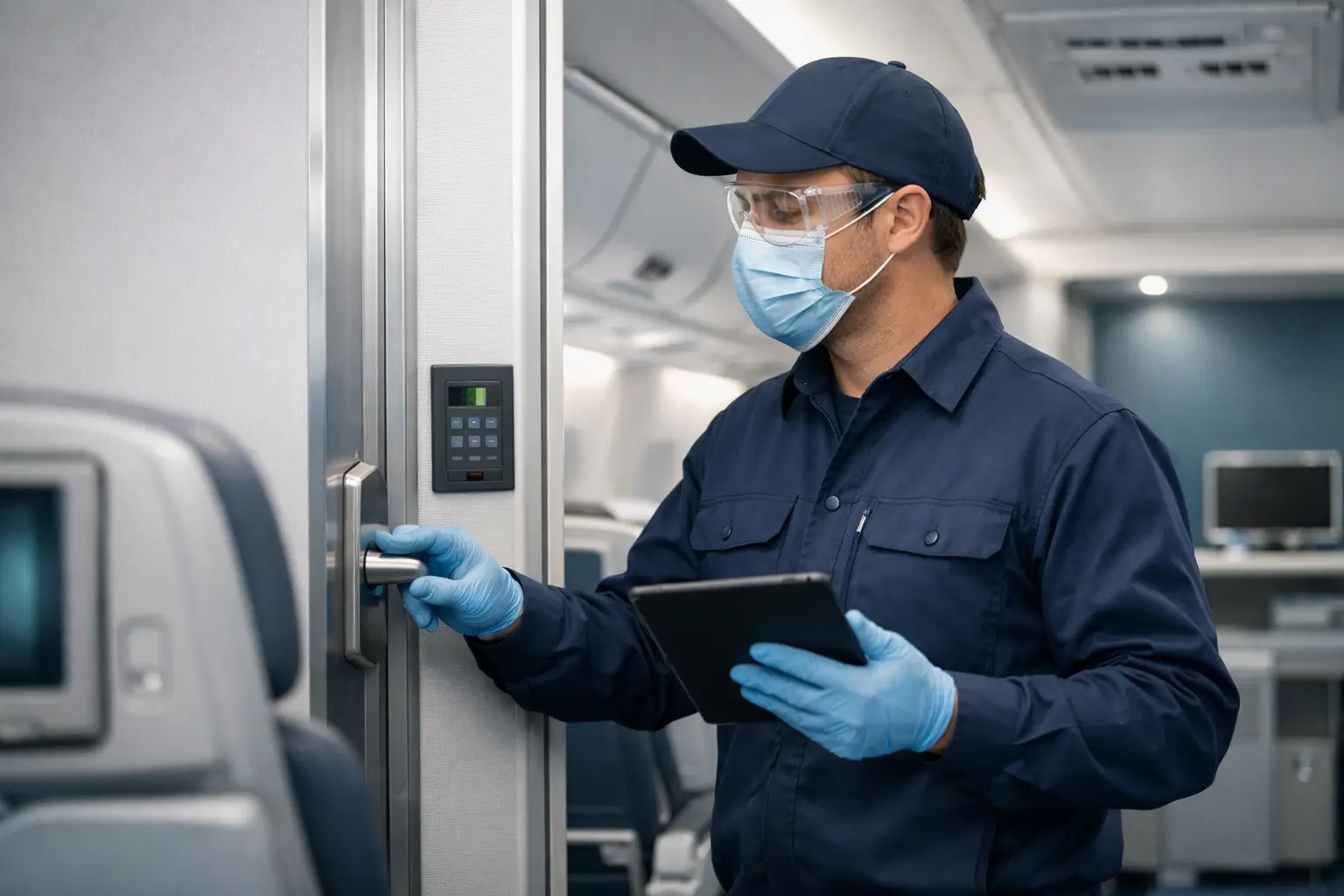
A cabin can be cleaned thoroughly at the gate and still present operational hygiene challenges by the next sector. Passengers, crew, catering activity, baggage handling interfaces and the aircraft’s own air movement create a changing risk pattern in a confined environment. An aircraft cabin disinfection service should therefore be planned as part of the turnaround and maintenance system, not treated as a generic spray applied between flights.
For airline operations teams, airport authorities and fleet managers, the question is not simply whether treatment can be carried out. The practical question is where it should be applied, how it will move through the cabin environment, which surfaces merit focused attention, and how the work can be completed without creating avoidable disruption. A controlled programme connects those decisions to the aircraft’s operating schedule.
Why aircraft cabins require a systems-led approach
Aircraft cabins bring together high passenger turnover, shared touchpoints and limited access windows. Seat areas, armrests, tray tables, lavatories, overhead lockers, call buttons, galley interfaces and crew work zones are used differently and at different frequencies. Treating every part of the cabin in precisely the same way may be simple to schedule, but it does not necessarily reflect how the environment is used.
Air movement also matters. Cabin ventilation is designed for passenger comfort and air management, but treatment planning must account for the physical pathways within the space. This does not mean interfering with or substituting aircraft ventilation maintenance. It means understanding how access points, airflow patterns, cabin layout and occupied zones influence the controlled dispersal of an approved treatment.
The operational constraint is equally significant. A long-haul aircraft on an overnight ground period allows for a different treatment plan from an aircraft completing a rapid domestic turnaround. The right service model depends on available time, aircraft type, cabin configuration, access permissions, existing cleaning routines and the required documentation.
What an aircraft cabin disinfection service should include
A professional service should begin with an assessment rather than a predetermined treatment checklist. The assessment establishes the cabin zones, likely contact points, ventilation-related access considerations, turnaround restrictions and any surface or equipment sensitivities identified by the operator.
From there, treatment can be designed around four connected stages: assess, disperse, distribute and maintain.
Assess the cabin and operating window
Assessment maps the practical environment. This includes passenger seating areas, premium cabins, lavatories, galleys, crew stations, entry points and areas that may receive high handling during boarding and servicing. It should also consider whether the aircraft is in service, undergoing cleaning, on a scheduled maintenance stop or being prepared for a special operation.
At this stage, the service provider and operator should agree access controls, work sequencing and release procedures. Aviation environments require clarity: who authorises access, which areas are excluded, what preparation is needed, and when the cabin may return to normal operational use.
Disperse treatment with controlled application
Where appropriate for the approved product, aircraft surfaces and enclosed areas may be treated through targeted antimicrobial application and ultra-low-volume fogging. ULV fogging produces a fine mist intended for controlled distribution, but it is not a shortcut for poor preparation or incomplete cleaning.
Application needs to be matched to the environment. Direct treatment may be appropriate for selected touchpoints, while controlled dispersal may support coverage of defined cabin zones. The method, dwell requirements, ventilation considerations and re-entry arrangements must follow product documentation, aircraft operator requirements and the agreed treatment scope.
The purpose is disciplined coverage, not visible residue or excessive application. More product is not automatically better. On an aircraft, the wrong approach can create unnecessary delays, affect sensitive finishes or complicate handover to the next operational team.
Distribute through relevant protection pathways
A cabin is not one uniform space. The passenger area, galley, lavatories and flight-attendant work areas each have different traffic patterns and material surfaces. Distribution should therefore be planned by zone, with attention to the pathways through which people, equipment and routine activity move.
This is where an engineered approach differs from a once-off response. Treatment is placed around the environment, not a generic checklist: high-contact surfaces where passengers interact with the cabin, operational touchpoints used by crew, and appropriate enclosed spaces where controlled dispersal is specified.
Any treatment associated with ventilation routes or air-handling interfaces must be planned carefully and only within the permissions and technical requirements set by the relevant aircraft operator and maintenance framework. It should never be assumed that a cabin treatment programme authorises work on aircraft systems.
Maintain the programme between treatments
Cabin hygiene depends on routine cleaning, correct waste handling, lavatory servicing, hand hygiene, ventilation maintenance and operational discipline. An antimicrobial treatment programme can support these controls, but it does not replace them.
Maintenance gives the service its operational value. Instead of relying on a single event, operators can review treatment intervals, cabin use patterns, seasonal pressure, charter activity and feedback from cleaning or engineering teams. This allows the programme to be adjusted when aircraft utilisation or operating constraints change.
Documented records should capture the treatment date, aircraft or cabin identifier, areas covered, method used, access restrictions and relevant handover details. For procurement and compliance stakeholders, this creates a clearer line between the planned scope and the work completed.
Designing around turnaround pressure
Turnaround windows are often the deciding factor in aviation hygiene planning. A service that requires unrealistic access time or disrupts boarding will struggle to become part of normal operations, however sound its technical intent may be.
For short ground windows, targeted application to agreed touchpoints and defined zones may be the practical option. For scheduled overnight periods or deeper cabin resets, the operator may be able to accommodate more extensive dispersal and verification activity. Neither is inherently superior. The appropriate approach depends on the operational objective and the time available to perform the work responsibly.
Sequencing also matters. Treatment may need to sit before, after or alongside particular cleaning activities, depending on the approved process. Cabin crews, cleaning contractors, engineering personnel and ground operations all need a shared understanding of the sequence. A well-designed programme reduces ambiguity at the gate.
Questions to ask before appointing a provider
A useful provider discussion should focus on process rather than broad claims. Ask how the cabin will be assessed, how the method changes for different aircraft layouts, how treatment is planned around turnaround windows, and what records will be supplied after each visit.
It is also reasonable to ask how the provider manages surface compatibility, restricted areas, ventilation-related considerations and access controls. Product claims, directions for use and technical evidence should always be read alongside the applicable product documentation and the scope of the relevant testing. Those details define what can responsibly be claimed for a specific treatment, surface and operating environment.
For South African operators managing mixed fleets, regional routes or variable ground support arrangements, nationwide delivery may be possible subject to site assessment, facility requirements and operational feasibility. The essential point is that the service should fit the aircraft and its operating reality, rather than forcing a standard process into an unsuitable window.
A practical hygiene layer for aviation operations
An aircraft cabin disinfection service is most useful when it becomes one managed layer within a wider cabin hygiene plan. It should be coordinated with cleaning teams, cabin presentation standards, engineering controls and the rhythm of aircraft movements.
Zoonex Systems approaches this work through physical pathways: airflow-related considerations, shared surfaces, high-traffic zones and operational access points. The aim is protection that moves through the environment in a controlled way, while respecting the limits of the aircraft, the product and the schedule.
The strongest programme is not the one with the broadest promise. It is the one that crew, cleaners, operations teams and facility leaders can repeat with confidence because it was designed around the environment they actually manage.
