
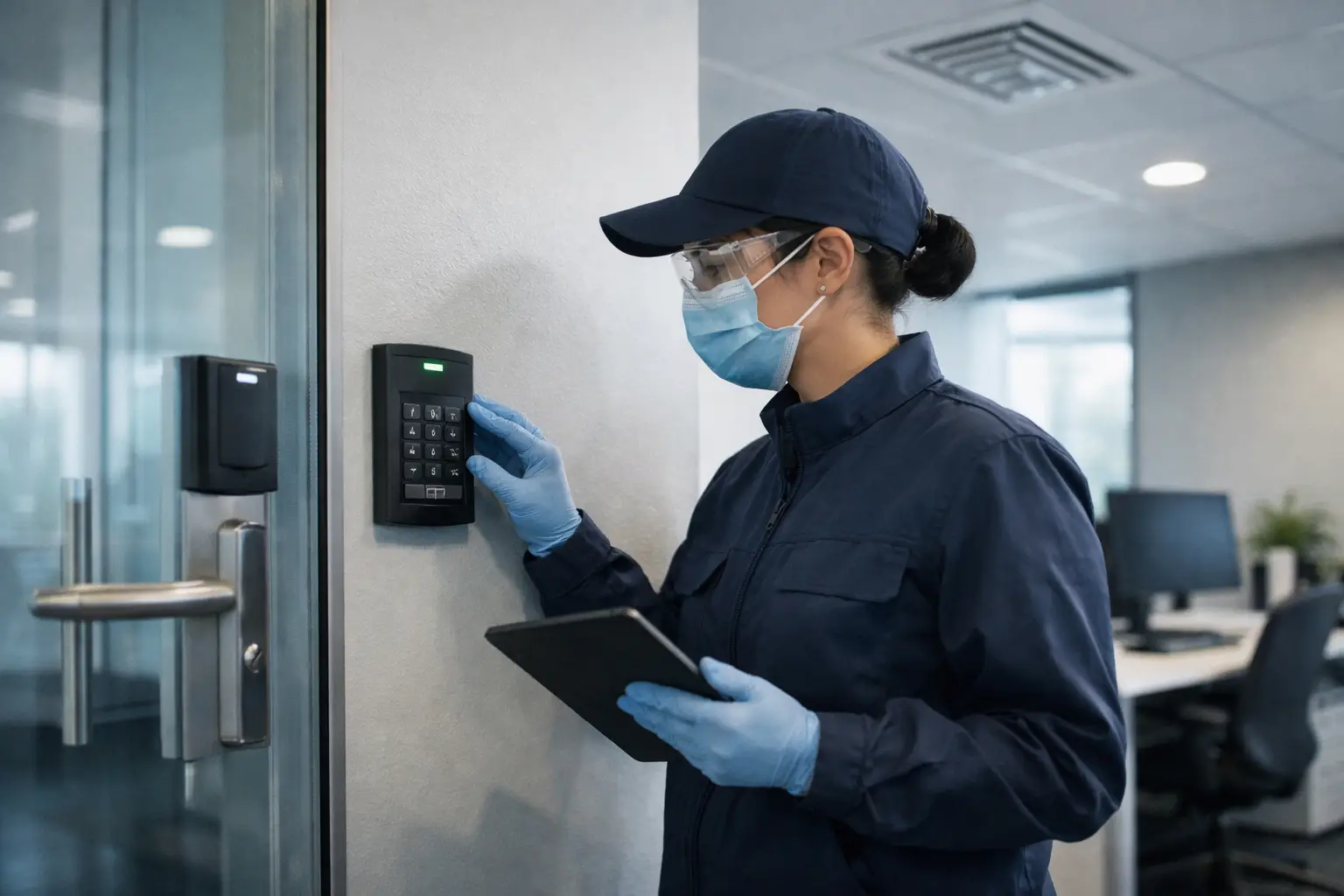
A treatment applied to the wrong surface, dispersed into an unsuitable space or introduced without operational controls can create avoidable risk. So, are antimicrobial treatments safe? They can be, when the product, application method, environment and maintenance plan are assessed as one system rather than treated as a simple spray-and-leave exercise.
For facilities managers and operational leaders, safety is not a single property of an antimicrobial product. It is the outcome of disciplined planning: understanding where contamination risk moves, selecting an appropriate treatment pathway, controlling exposure during application and maintaining the wider hygiene system afterwards. A responsible programme protects the people using the space while respecting its airflow, materials, equipment and daily operating requirements.
Are antimicrobial treatments safe? It depends on the system
An antimicrobial treatment may be intended for a particular use, but its suitability changes with the environment. A hotel reception desk, hospital waiting area, livestock handling zone, aircraft cabin, restaurant back-of-house area and commercial HVAC route all present different surfaces, occupancy patterns and operational constraints.
Safety therefore begins before any treatment is deployed. The questions are practical: What materials are present? Is the area occupied continuously or intermittently? How does air move through the building? Which touchpoints receive the highest traffic? Are there sensitive assets, food-contact areas or specialist environmental controls that require separate consideration?
The same principle applies to application technique. A targeted surface application is not interchangeable with ultra-low-volume fogging, and neither is automatically appropriate for a ventilation pathway. Each approach distributes treatment differently. Using the right method in the right zone is central to managing both performance and safety.
A professionally managed programme should also distinguish between antimicrobial treatment and the wider hygiene measures a facility already needs. Treatment does not replace routine cleaning, planned disinfection where required, hand hygiene, ventilation maintenance, waste management or established infection-prevention procedures. It is one protection pathway within a broader operational control plan.
Safety starts with assessment, not application
Facilities are physical systems. Contamination can be transferred through hands, equipment, shared work areas, vehicle interiors and airflow routes. A treatment plan that ignores those pathways may leave gaps, create unnecessary disruption or apply product where it is not needed.
At Zoonex Systems, the starting point is an assessment of the environment rather than a generic checklist. That means reviewing treatment zones, airflow behaviour, occupancy, surface types, equipment layout and the practical windows available for work. In a busy facility, the safest application plan is often the one that is carefully sequenced around operations, access controls and re-entry requirements.
This assessment stage should identify exclusions as clearly as treatment areas. Certain materials, sensitive equipment, food-related processes and occupied spaces may need specific controls, alternative methods or no treatment at all unless supported by the applicable product documentation. Assumptions are not a safety process.
Product documentation matters here. Technical claims, use instructions, surface compatibility information, safety data and the stated scope of testing should be reviewed alongside the actual site conditions. A product can be suitable in one controlled setting and unsuitable in another. Facility decision-makers should expect that distinction to be made explicit.
Controlled dispersal reduces unnecessary exposure
Once the treatment design is agreed, safe deployment depends on control. This includes preparation of the area, trained operators, appropriate equipment, defined treatment boundaries and clear procedures for occupancy and re-entry.
For direct surface treatment, the focus is on applying the product to specified touchpoints and operational surfaces at an appropriate rate and coverage. The objective is not to saturate every available surface. It is to treat defined risk areas in a controlled manner, with attention to material compatibility and the manufacturer’s use instructions.
Ultra-low-volume fogging can distribute a fine treatment mist across suitable enclosed spaces, but it must not be treated as a shortcut. Fogging requires particular care because dispersal behaviour is influenced by room size, air movement, ventilation status, contents, access points and occupancy. It should be planned and performed only within a controlled professional process, with the room managed according to the relevant product and site requirements.
Ventilation-pathway treatment needs the same discipline. Air handling systems can connect multiple spaces, which makes them operationally significant but also technically sensitive. A suitable approach considers the route of airflow, access points, filters, coils, ducts and maintenance schedules. Protection that moves through the building must be designed around how the building actually moves air.
Distribution must match the environment
A sound antimicrobial programme follows the physical routes that shape risk. In an office, this may mean shared entrances, lifts, meeting rooms, washrooms, equipment rooms and HVAC pathways. In hospitality, it may extend through guest circulation areas, housekeeping routes, kitchens where permitted by product documentation and back-of-house operational zones.
In agriculture and biosecurity settings, movement between people, vehicles, work areas and controlled zones can be more relevant than a single room. Aviation and fleet environments bring their own constraints: short turnaround times, mixed material finishes, high passenger or crew touchpoints, confined spaces and tightly managed access. The application design must fit the operating environment, not disrupt it.
This is why a one-size-fits-all treatment schedule can be misleading. Frequency, method and coverage should respond to traffic levels, cleaning routines, changes in occupancy, environmental conditions and the consequence of operational downtime. A lower-risk archive room and a high-turnover reception area do not require the same intervention simply because they sit within the same building.
Maintenance keeps the programme accountable
The question is not only whether a treatment is safe on application day. It is whether it remains appropriately managed as the facility changes. Cleaning activity, refurbishment, new equipment, altered airflow, seasonal occupancy and revised operating practices can all affect the original treatment plan.
A managed maintenance routine provides the opportunity to review those changes and adjust the programme. This is the final stage of a systems-led approach: assess, disperse, distribute and maintain. The sequence matters because maintenance without a clear initial assessment becomes routine activity without a defined risk rationale.
Documentation is part of safety, not administrative excess. Clear records of treatment zones, application dates, operating controls, product information and observations from follow-up visits help facilities teams understand what has been done and where responsibilities sit. They also support more informed coordination between operations, cleaning teams, engineering teams and health or safety stakeholders.
What facility leaders should ask before approving treatment
Before proceeding, decision-makers should be able to obtain clear answers about the intended use, proposed application method, areas included and excluded, preparation requirements, access restrictions and the relationship between treatment and routine hygiene measures. They should also understand who is responsible for site coordination and what documentation will be provided.
It is reasonable to ask how the programme accounts for ventilation, high-touch activity, sensitive surfaces and business continuity. The strongest answer will refer to the facility itself, not a standard promise that could apply equally to every building.
A responsible provider should be equally willing to identify limits. Antimicrobial treatment is not a claim that a facility is sterile, infection-free or protected from every contamination event. Its value lies in adding a considered control pathway to the places where people, surfaces, equipment and air movement meet.
A safer decision is an engineered one
For hygiene-critical environments, the safest antimicrobial treatment is usually not the most visible intervention. It is the one that has been assessed carefully, applied under control, distributed through appropriate pathways and maintained as part of normal facility management.
That approach gives operational teams something more useful than a once-off event: a programme designed around the environment, with practical boundaries, documented decisions and protection that works alongside the controls the facility already relies on.
