
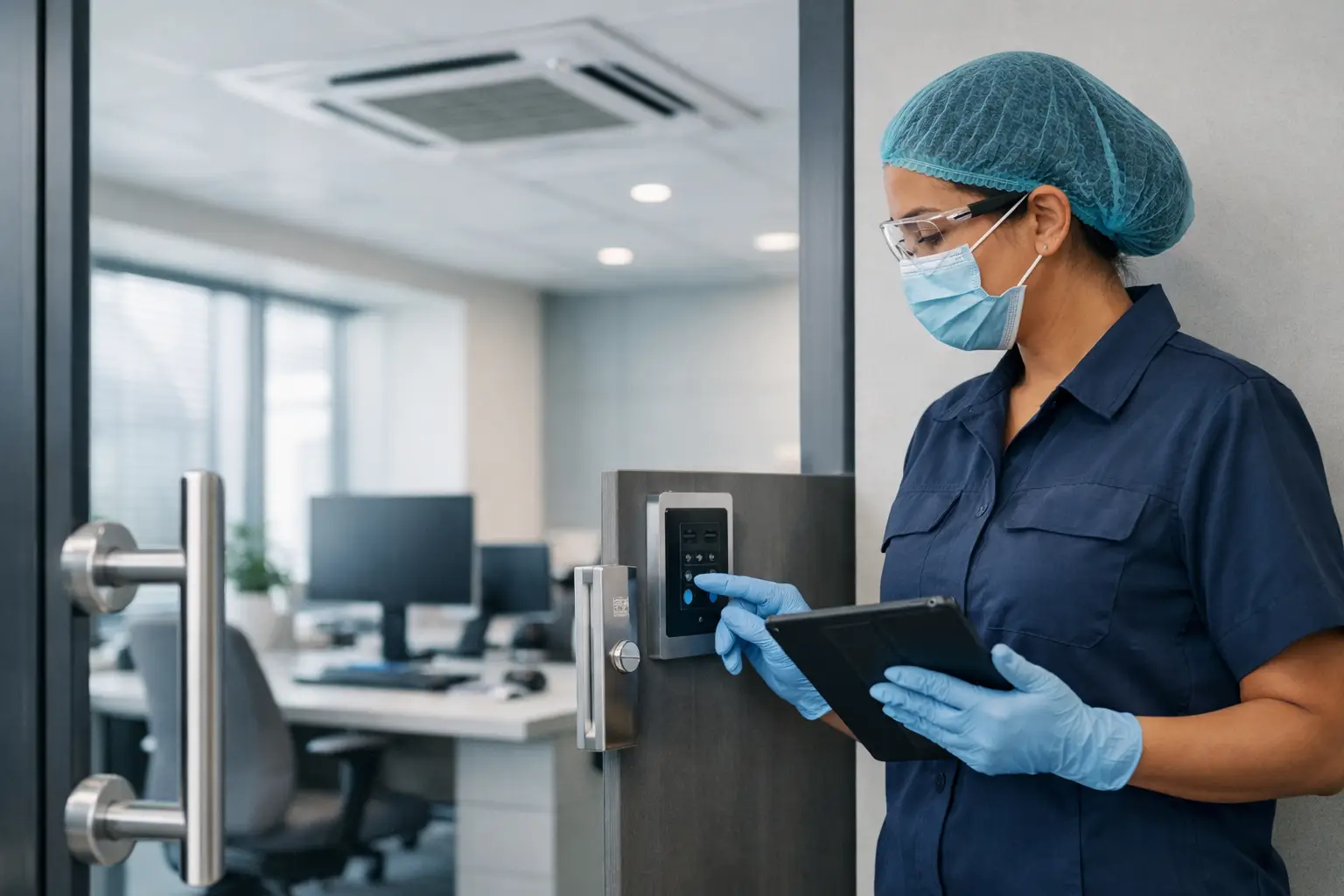
A reception desk can look freshly cleaned at 08:00 and still sit within a wider contamination-risk pattern shaped by shared air, occupancy, touchpoints and movement through the building. That is the practical issue behind air treatment versus surface cleaning. Facilities do not need to choose one control and disregard the other. They need to understand what each pathway addresses, where its limits sit, and how both can be designed around the way a site actually operates.
For a hospital ward, hotel corridor, food-service area, livestock facility or aircraft turnaround environment, hygiene risk rarely stays in one place. People move between zones. Air moves through ventilation routes. Equipment, doors, rails, controls and workstations are touched repeatedly. A credible antimicrobial programme therefore considers both the surfaces people contact and the physical pathways that connect occupied spaces.
Air treatment versus surface cleaning: different pathways, one system
Surface cleaning and disinfection focus on accessible materials and high-contact areas. This includes desks, handles, counters, seating, equipment exteriors and shared controls. It remains an essential operational discipline because it removes visible soil and addresses contamination on defined surfaces. The quality of the result depends on the product used, the method, the preparation of the surface, contact conditions and the consistency of the cleaning routine.
Air treatment works on a different pathway. It considers how treatment can be dispersed and distributed through air-handling and ventilation-related routes, occupied zones and difficult-to-reach parts of the operational environment. It is not a substitute for routine cleaning, mechanical ventilation maintenance, hand hygiene or established infection-prevention procedures. Its value lies in extending the protection strategy beyond the places a cleaning operative can reach directly during a standard round.
The distinction matters because a facility is not simply a collection of rooms. It is a connected system. A clean touchpoint can be re-exposed through normal use, while a well-managed airflow route may still lead to recurring concern if high-traffic surfaces are treated inconsistently. One system, multiple protection pathways is usually more practical than relying on a single intervention to carry the full burden.
What surface cleaning does well
Routine surface cleaning is the front line of visible hygiene control. It is immediate, familiar to teams and adaptable to changing conditions. When a spill occurs, a patient area changes over, a restaurant table turns, or a vehicle is prepared for its next shift, direct cleaning is the appropriate response.
It also allows facilities teams to focus effort where occupancy creates predictable pressure. Entrance touchpoints, lift buttons, shared screens, washroom fittings, break areas and equipment controls can be included in documented schedules and checked through normal supervision.
Its limitation is coverage over time. Surface cleaning is usually periodic and location-specific. It may be affected by missed points, cleaning access, shift changes, workload peaks and the simple reality that new contact begins as soon as an area is reopened. In large or complex buildings, a checklist can support consistency, but it cannot on its own account for airflow, movement between zones or areas that are impractical to access manually.
What air treatment adds to the plan
Engineered air treatment begins with distribution rather than a generic spray routine. The question is not merely whether a treatment can be applied. It is how it can move through the relevant environment, where it is likely to settle or interact, and how application can be planned without creating unnecessary disruption.
Depending on the facility and approved treatment scope, this can include ventilation-pathway treatment and controlled ultra-low-volume fogging for selected operational spaces. Such work must be planned by trained professionals with attention to occupancy, ventilation configuration, access controls, equipment sensitivity, application zones and reopening requirements. Fogging is not a do-it-yourself substitute for cleaning, and it should never be treated as a shortcut around proper site preparation or safety procedures.
Air treatment is particularly relevant where air is shared across busy areas, where operational layouts create repeated movement between spaces, or where direct access to every relevant surface is constrained. Examples include back-of-house hospitality areas, commercial offices with central HVAC, transport fleets, large agricultural buildings and aviation environments with tight turnaround windows.
That does not mean every facility needs the same treatment pattern. A small office with low occupancy and good cleaning discipline may need a focused approach to shared touchpoints and selected airflow routes. A multi-zone healthcare or logistics facility may require more detailed zoning, sequencing and managed maintenance. The appropriate decision depends on the environment, not a generic checklist.
The operational question: where does risk travel?
Facilities managers often receive cleaning reports organised by room or task. That is useful, but it is only one view of the site. A systems-led assessment also asks how people, air and equipment travel through the building.
Consider a busy hospitality property. Guests interact with reception counters, lifts, dining spaces and corridor touchpoints. Staff move between guest areas, kitchens, laundry routes and service zones. Surface cleaning can target the points of contact, while an engineered programme can consider the ventilation and treatment pathways connecting those occupied areas.
In an agricultural or biosecurity setting, the route may involve vehicle cabs, staff entry points, equipment, animal-adjacent operational zones and airflow through enclosed workspaces. In aviation, the focus may include cabins, crew areas, ground equipment and controlled turnaround processes. The principle remains the same: map the pathways first, then determine how cleaning and treatment controls can support each other.
A four-stage approach to integrated protection
A managed programme is more reliable when it follows a repeatable operating method. Zoonex Systems frames this as assess, disperse, distribute and maintain.
Assess
Assessment establishes the operating reality. This includes the facility layout, occupancy profile, ventilation routes, high-touch surfaces, operational hours, sensitive zones and access limitations. It should also identify where routine cleaning is already strong and where coverage may be inconsistent. The purpose is not to criticise the existing team. It is to build an intervention around the conditions they manage every day.
Disperse
Dispersal concerns the controlled method used to introduce treatment into selected spaces or pathways. The treatment method must fit the site, its operating constraints and applicable product documentation. Timing, isolation of treatment zones, ventilation management and equipment considerations all require planning. A programme that creates avoidable downtime is unlikely to be maintained well.
Distribute
Distribution considers where treatment moves and where it is intended to reach. In ventilation-related work, this means understanding the physical routes that shape airflow. In occupied spaces, it means considering the relationship between treatment zones, touchpoints, traffic flow and equipment. This is the step that turns an application into a site-specific protection design.
Maintain
Protection has to fit ongoing operations. Cleaning schedules continue. HVAC maintenance continues. Teams continue to use shared spaces and equipment. Managed maintenance provides a structured way to review treatment intervals, changing occupancy, operational incidents and new risk areas. It also supports documentation, which is valuable for internal governance, contractor oversight and stakeholder confidence.
Choosing priorities without over-treating the site
The strongest programme is not necessarily the one that treats every square metre in the same way. Overly broad routines can waste time, disrupt operations and obscure the areas that need most attention. Priorities should be based on activity, exposure pathways and the facility’s ability to maintain the programme.
High-traffic public areas may call for frequent surface attention alongside treatment of relevant shared-air pathways. Low-occupancy storage areas may need a different level of focus. A 24-hour healthcare environment has different constraints from a restaurant between services or a fleet depot during scheduled downtime. There is no universal interval or one-size-fits-all scope that can responsibly be applied without assessment.
Decision-makers should also separate treatment claims from operational outcomes. Technical claims must be read alongside applicable product documentation, approved use conditions and the scope of relevant testing. The practical measure of a programme is whether it can be applied responsibly, documented clearly and sustained alongside the facility’s existing hygiene controls.
Make hygiene work with the building
The most useful comparison is not air treatment against surface cleaning. It is a question of whether hygiene measures reflect how the building is used. Cleaning deals directly with the surfaces people see and touch. Air treatment extends planning into the pathways that move through the facility. When both are assessed, applied and maintained as connected controls, hygiene becomes less dependent on a once-off event and more aligned with daily operations.
For facilities under constant pressure, that is the helpful starting point: follow the movement of people, air and equipment, then build protection around the environment they create.
