
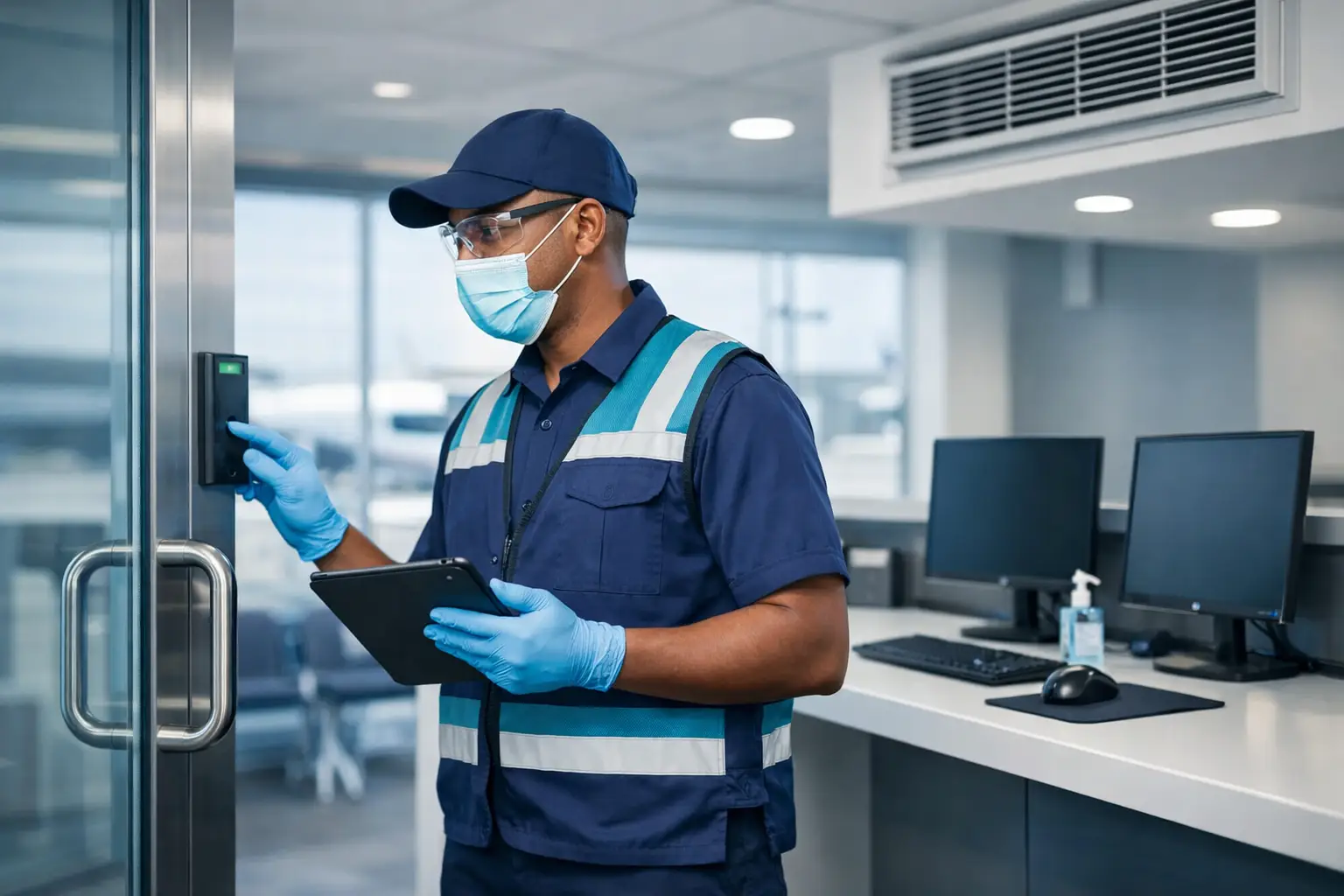
A busy terminal can look clean while its hygiene controls remain disconnected. Airport hygiene priorities must account for the routes people, air, baggage, equipment and staff take through the facility – not only the surfaces visible from the concourse. The practical question for airport authorities and operations teams is whether protection is designed around those routes, or applied as a generic checklist after the fact.
Airports present a particular operational challenge. Passenger volumes rise and fall quickly, dwell times differ by zone, turnaround schedules leave little room for disruption, and the boundary between public, staff and transport areas is constantly shifting. An effective programme therefore needs to support routine cleaning and established infection-prevention controls while adding treatment where contamination pressure, airflow and shared contact converge.
Why airport hygiene priorities start with movement
A terminal is not one environment. Check-in halls, security lanes, departure gates, arrivals corridors, lounges, staff rooms, baggage areas, ablutions, shuttle vehicles and aircraft-support spaces all operate differently. Each has its own occupancy pattern, surface mix, cleaning window and ventilation arrangement.
A check-in kiosk may receive hundreds of brief interactions in a day. A gate seating area can experience concentrated occupancy before boarding, then become quiet. A staff dispatch room may have fewer people but repeated contact with radios, keyboards, door hardware and shared equipment. Treating these locations identically can waste effort in low-pressure areas while leaving critical pathways under-addressed.
This is why visible cleanliness is only one part of the picture. Hygiene planning must follow movement through the building: where people queue, pause, touch, transfer items and enter spaces served by common ventilation routes. Protection that moves through the building should be considered alongside the cleaning teams, maintenance teams and operational managers who keep the airport functioning.
The priority zones that deserve closer planning
The highest-priority zones are usually those where shared contact, occupancy density and operational consequence overlap. The exact order depends on the terminal design, airline schedules and local procedures, but several areas consistently require attention.
Passenger touchpoints and queue infrastructure
Self-service kiosks, counter ledges, tray return points, handrails, lift buttons, washroom fittings, gate desks and seating arms are touched by many users in short succession. These surfaces need a cleaning regime that matches their use, but they also benefit from an assessment of material compatibility and treatment coverage.
The goal is not to treat every square metre in the same way. It is to identify repeated-contact points and ensure that routine cleaning, targeted antimicrobial surface application and inspection practices work together. High-touch surfaces often include different materials within a few metres – coated metals, plastics, glass, laminates and painted finishes – so a site-specific approach matters.
Ventilation pathways and enclosed shared spaces
Air moves contamination risk beyond the surface where it begins. Airport hygiene priorities should therefore include the ventilation pathways serving enclosed or heavily occupied zones, particularly where operating hours, occupancy peaks and maintenance access create constraints.
This does not mean treating ventilation as a substitute for mechanical maintenance. Filters, coils, ducts, air handling equipment and airflow performance still require planned inspection and maintenance by the appropriate specialists. The hygiene programme should instead be coordinated with those activities, considering where treatment can be distributed through relevant pathways without interfering with the facility’s operating requirements.
Staff, service and back-of-house areas
Public areas receive attention because they are visible. Yet back-of-house environments can have sustained use across shifts: security offices, crew rooms, loading areas, workshops, maintenance stores, transport vehicles and shared administration spaces. These areas often contain high-use equipment and less predictable cleaning opportunities.
Including them in the treatment plan helps create one system across public-facing and operational zones. It also avoids a common gap in which a terminal concourse is prioritised while the spaces supporting daily airport operations are treated as separate hygiene problems.
Transport interfaces and turnaround spaces
Buses, staff shuttles, baggage handling vehicles and other shared operational vehicles introduce another layer of movement. Their confined interiors, changing users and limited turnaround windows require carefully scheduled work. The same applies to selected ground-support spaces where teams and equipment rotate rapidly.
The right approach depends on vehicle materials, access windows and the approved application method. Treatment planning should be controlled and documented, with clear responsibilities for vehicle operators, facilities teams and service providers.
A four-stage method for airport environments
For complex facilities, a managed programme is more useful than a once-off response. Zoonex Systems frames this work through four connected stages: assess, disperse, distribute and maintain.
Assess the physical environment
Assessment begins with the airport’s actual operating conditions. This includes reviewing occupancy patterns, touchpoint density, cleaning routines, air handling routes, accessible treatment windows, materials, restricted areas and interfaces between contractors. It should also establish where normal operations cannot be interrupted and where work must take place after hours or between flight banks.
The output is a treatment map rather than a broad promise. It identifies priority zones, appropriate application pathways and the sequencing needed to fit the airport’s daily rhythm. In a regional terminal, for example, the main pressure may be concentrated around short departure peaks. In a larger airport, baggage, staff circulation and multiple terminal zones may require a more segmented plan.
Disperse treatment in a controlled manner
Where ULV fogging is appropriate for the assessed environment, it should be deployed by trained professionals under controlled conditions. The purpose is to disperse treatment across defined spaces where conventional wipe-down methods may not reach consistently, while respecting access controls, equipment considerations and reopening procedures.
ULV fogging is not a shortcut for poor cleaning practice, nor should it be treated as a stand-alone answer. Its value depends on the selected treatment zone, the product documentation, the application method and the operational controls around it. Sensitive areas, equipment and materials require separate consideration before any programme is approved.
Distribute through relevant protection pathways
Distribution considers how treatment reaches the areas that shape hygiene risk. That may include targeted surfaces, shared equipment, defined high-traffic zones and, where suitable, ventilation-linked pathways. The principle is simple: treatment design should reflect the way the facility is used.
For airports, this can mean separating passenger-facing touchpoint plans from staff-area plans, then coordinating both with air handling and cleaning schedules. A single generic application pattern rarely reflects the variation between a security queue, a gate lounge, a washroom, a vehicle cabin and a plant room.
Maintain the programme as operations change
Airport conditions are not static. Seasonal travel, airline schedules, tenant changes, refurbishments, ventilation work and altered passenger flows can all change the risk profile. Managed maintenance provides an opportunity to review treatment zones, record completed work and adjust the programme when the environment changes.
Documentation matters here. Facilities leaders need a clear record of what was assessed, where treatment was applied, the conditions under which it was applied and what follow-up is required. Technical claims should always be read alongside applicable product documentation, test scope and site-specific instructions.
Balancing hygiene protection with airport continuity
The strongest hygiene plan is one that can actually be delivered without creating avoidable disruption. A treatment programme may need to work around night cleaning, security restrictions, tenant access, engineering permits, baggage operations and flight schedules. In some cases, phased work across smaller zones is preferable to a large intervention. In others, a planned closure window offers better access and more controlled execution.
Procurement and operations teams should also distinguish between frequency and fit. More treatment is not automatically better if it is poorly targeted, incompatible with surfaces or difficult to maintain. The useful measure is whether controls are proportionate to the environment and can be repeated consistently under real operating pressure.
For South African airports, this planning can also require coordination across multiple service providers and geographically dispersed facilities. Site assessment remains essential because terminal layouts, climate conditions, infrastructure age and operating models vary considerably.
A well-run airport hygiene programme is rarely noticed by passengers, and that is the point. It should sit behind the journey: planned around airflow, touchpoints, treatment zones and maintenance routines, while allowing the airport to keep moving.
