
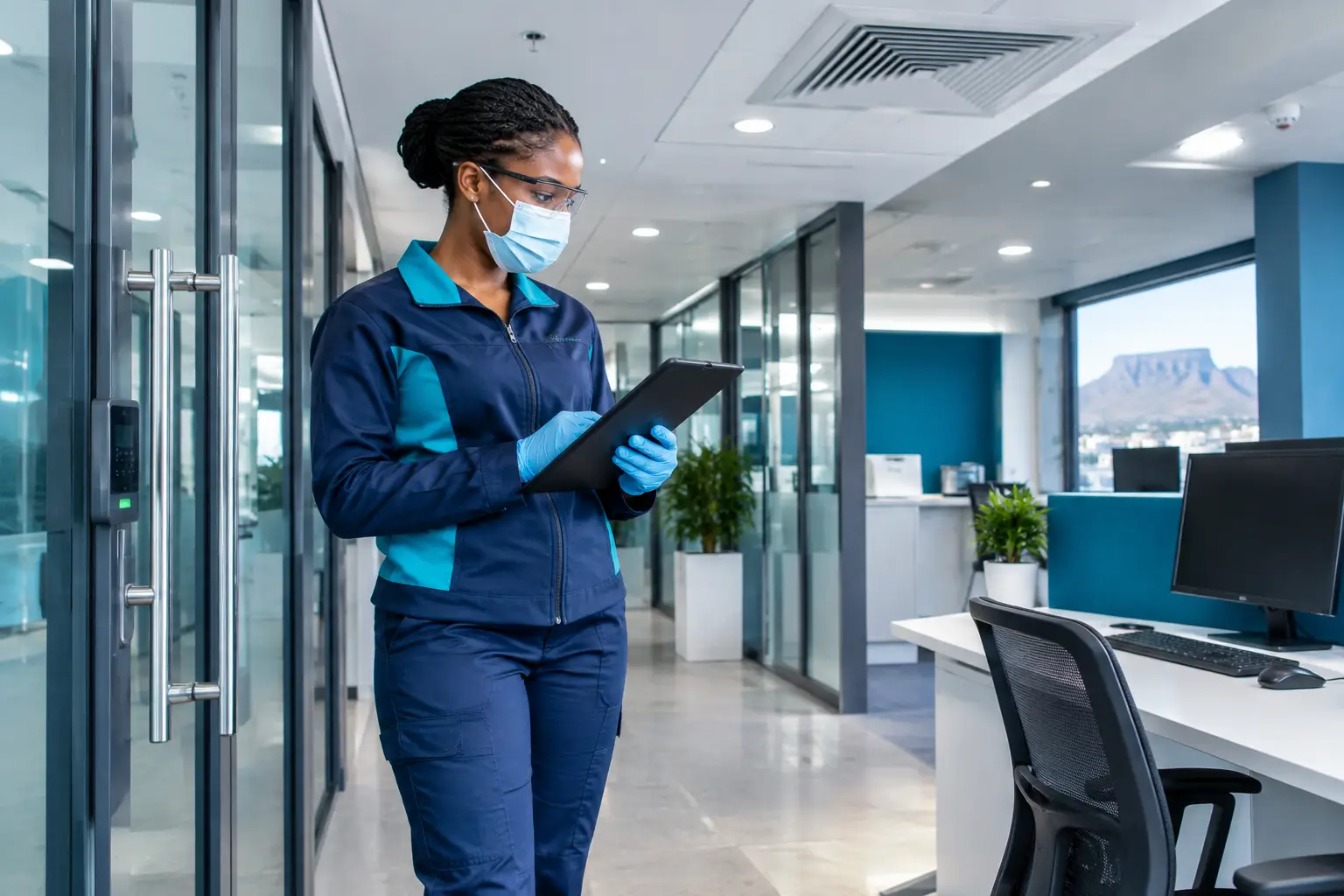
A reception desk may be cleaned repeatedly during the day while the adjoining meeting room, return-air grille, lift lobby and shared equipment follow a very different contamination pathway. Antimicrobial fogging is valuable when it is planned around those connected spaces rather than treated as a quick response to a visible hygiene concern. The objective is controlled distribution: placing a suitable antimicrobial treatment where people move, where air moves and where routine cleaning cannot always reach consistently.
For facilities managers, the practical question is not simply whether fogging can cover an area. It is whether the application supports the wider hygiene plan without disrupting operations, affecting sensitive zones or creating a false sense of security. A professionally designed programme considers the building as a system of rooms, surfaces, ventilation routes, touchpoints and operating patterns.
What antimicrobial fogging is designed to do
Ultra-low-volume, or ULV, fogging converts a professionally selected treatment into very fine droplets. This allows the treatment to be dispersed across defined spaces and onto accessible surfaces with controlled coverage. It can be useful in areas with complex layouts, frequent shared use or many touchpoints, including offices, hospitality spaces, vehicle interiors, operational rooms and selected back-of-house environments.
Fogging is a distribution method, not a substitute for cleaning. Dirt, grease and organic residue can interfere with surface treatment performance, which is why routine cleaning remains foundational. Hand hygiene, ventilation maintenance, cleaning schedules and infection-prevention procedures also retain their own roles. The strongest result comes from connecting these controls, not asking one application method to carry the whole burden.
A well-managed programme also distinguishes between the air in a room and the physical pathways that influence where particles and people travel. Doors opening during peak periods, pressure differences between rooms, supply and return vents, occupancy density and the movement of trolleys, luggage or equipment can all change the practical treatment plan.
Why a generic fogging checklist falls short
Two facilities with the same floor area may need very different approaches. A clinic waiting area has changing patient flow, short dwell times and numerous high-touch surfaces. A hotel may need treatment scheduled between guest turnover and housekeeping activity. A food-service operation may require careful separation of treatment zones from food-handling processes and production schedules. In a livestock or agricultural environment, biosecurity routes, vehicles and equipment may be more relevant than a conventional room-by-room layout.
The limitation of a generic checklist is that it treats every room as though exposure, airflow and operational constraints are identical. They are not. A fogging programme should define what is being treated, why that zone matters, when it can be accessed and what controls must be in place before staff or occupants return.
This does not mean every site needs the same level of complexity. A small office may require a focused plan for shared workstations, meeting rooms and ventilation-adjacent areas. A hospital, airport facility or large commercial property may require phased deployment, zone records, access controls and coordination with several operational teams. The scale changes, but the systems thinking remains the same.
Antimicrobial fogging follows four operational stages
Zoonex Systems approaches engineered antimicrobial protection through four connected stages: assess, disperse, distribute and maintain. This framework keeps fogging tied to the conditions of the facility rather than treating it as an isolated event.
Assess the environment before selecting the method
Assessment starts with the physical environment. Teams review the layout, occupancy pattern, surface types, ventilation pathways, critical touchpoints and operational restrictions. They identify whether a space is continuously occupied, used in shifts, intermittently closed or subject to strict access requirements.
The assessment should also establish what routine cleaning already covers well and where gaps may exist. For example, a cleaning team may effectively manage visible high-touch points but have limited access to ceiling-level services, awkward equipment housings or consistently busy shared zones. The purpose is not to duplicate work without reason. It is to design coverage around real operational exposure.
Disperse treatment with control
ULV equipment is selected and operated to achieve controlled dispersion within the intended zone. Droplet behaviour, room geometry, air movement and application timing all matter. Open doors, active extraction, strong supply air and unnecessary movement through the area can affect where treatment settles and how consistently it is distributed.
This is why trained deployment and site-specific procedures matter. Fogging should not be improvised by untrained personnel or treated as a do-it-yourself maintenance task. Product instructions, site safety processes, required exclusion periods and re-entry conditions must guide each application.
Distribute through the pathways that shape risk
Distribution is broader than standing in the middle of a room and fogging in all directions. It considers the connected routes within the facility: reception counters, lift areas, shared work zones, equipment interfaces, vehicle cabins, corridors, service passages and ventilation-related pathways where appropriate.
The aim is protection that moves through the building in step with the building’s use. In a commercial property, this may mean targeting lobby-to-lift movement and shared amenities. In hospitality, it may mean coordinating guest-facing zones and operational back-of-house areas. For fleet operations, it can mean treating vehicle interiors within a controlled turnaround process.
Maintain the programme rather than relying on a once-off event
Treatment has greater operational value when it is reviewed and maintained. Occupancy can change, a reception area may be reconfigured, seasonal demand can increase traffic, or maintenance works may alter airflow patterns. Each change can affect the suitability of the original treatment design.
Managed maintenance routines create a basis for re-assessment, documented deployment and coordination with cleaning and facilities teams. They also support continuity: the programme can be scheduled around operating hours, planned shutdowns, occupancy peaks and sensitive activities rather than introduced as an avoidable interruption.
Where fogging fits in a facility-wide hygiene plan
Antimicrobial fogging is generally most useful where there is a clear reason to improve the consistency or reach of a surface-treatment programme. That may include high-traffic shared areas, complex operational spaces, periodically vacant rooms, vehicle fleets or facilities with demanding turnover requirements.
It is less useful when the underlying issue has not been identified. Poor ventilation maintenance, inadequate cleaning access, overcrowded storage areas or unclear responsibility for touchpoints cannot be solved by adding another treatment event. Those conditions need operational correction first, or alongside the programme.
For healthcare and care environments, treatment plans need particular discipline around patient activity, cleaning protocols, equipment restrictions and infection-prevention governance. In aviation and transport settings, turnaround windows, material compatibility and passenger operations shape what is feasible. In agricultural and biosecurity settings, movement routes, equipment controls and site separation often determine priorities. The method may be similar, but the treatment design should never be copied blindly from one sector to another.
Documentation is part of responsible application
A credible fogging programme should leave more than a treated space. It should provide clarity on the scope of work, defined zones, scheduling, operating conditions and ongoing maintenance requirements. This helps facilities teams coordinate access, communicate with occupants and evaluate whether the programme still reflects how the site is being used.
Technical claims must always be read alongside the applicable product documentation, instructions for use and test scope. Performance can depend on the product, surface, application method, environmental conditions and the specific organism or material assessed. Broad statements without that context are not a sound basis for operational decision-making.
The same principle applies to sensitive spaces and assets. Before any deployment, the provider and facility team should establish restrictions around equipment, materials, ventilation controls, food-related zones, animals, occupied areas and other site-specific requirements. Responsible antimicrobial treatment is controlled precisely because every facility has boundaries that must be respected.
A useful next step is to walk the site as it operates, not as it appears on a floor plan. Follow the route of a visitor, staff member, trolley, vehicle or air stream through the day. That view often reveals where a managed antimicrobial programme can add practical value – and where better cleaning, maintenance or process control should lead instead.
