
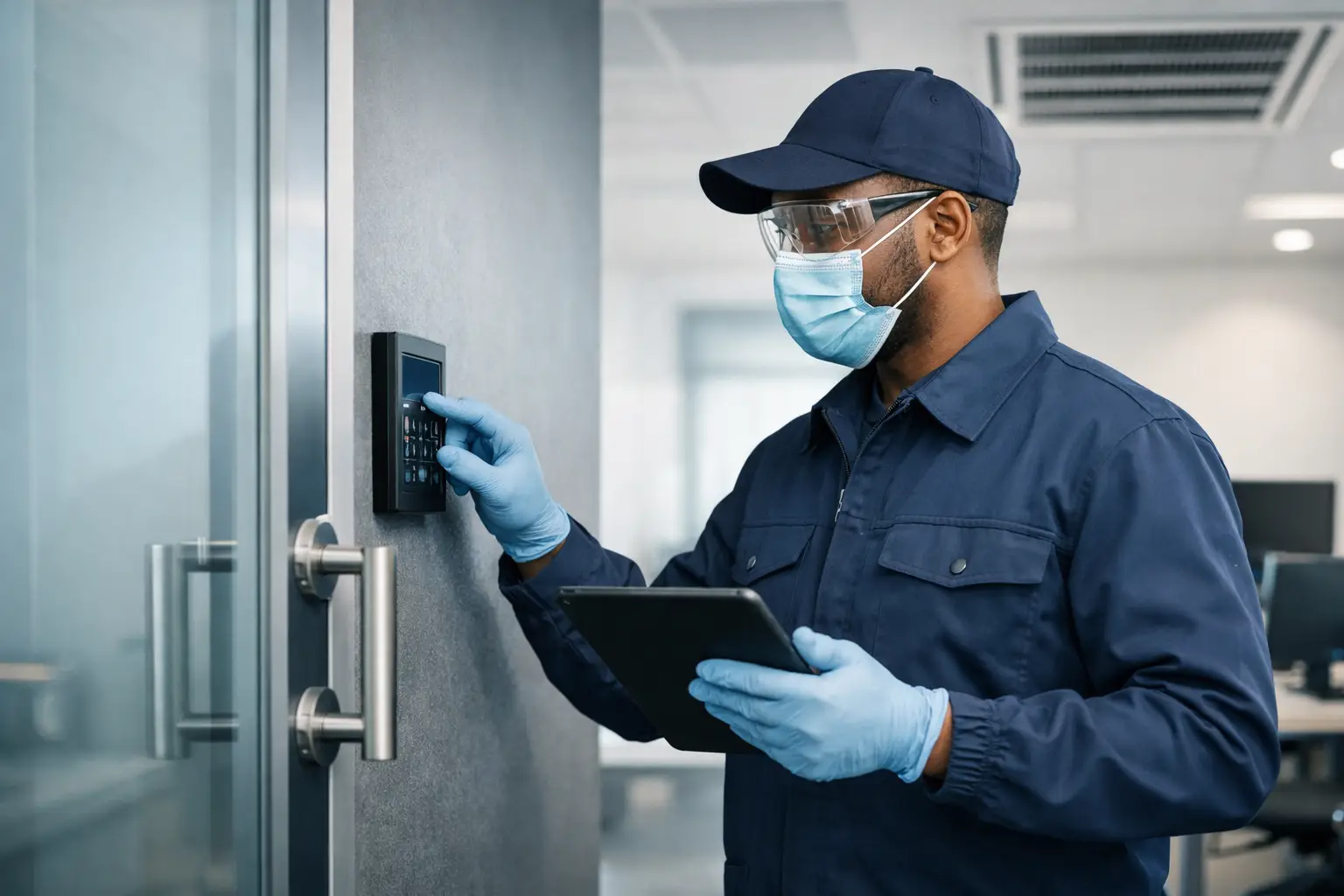
A reception desk can be cleaned at 08:00 and used by dozens of people before lunchtime. At the same time, air moves through ducts, shared equipment changes hands, and operational teams work around cleaning schedules, visitors and peak occupancy. Facility resilience begins with recognising that hygiene risk does not remain on one visible surface or in one room.
For facilities managers, the practical question is not whether cleaning matters. It does. The question is whether routine cleaning, ventilation maintenance and existing controls are connected to the way people, air and equipment actually move through the building. Where they are not, protection is often fragmented: thorough in one area, inconsistent in another and difficult to sustain under operational pressure.
What facility resilience means in practice
Facility resilience is the capacity to maintain safe, orderly and dependable operations when hygiene pressures, changing occupancy and environmental demands increase. It is not a claim that a site can eliminate all contamination risk. It is a disciplined way of reducing avoidable exposure points, supporting existing controls and making hygiene planning workable over time.
In a hospital, this may mean considering waiting areas, staff rooms, patient-transfer routes and ventilation pathways alongside scheduled cleaning. In a hotel, it may involve guest touchpoints, back-of-house workspaces, laundry routes and busy public areas. A food-service operator may need to account for service counters, staff circulation, delivery zones and equipment handling without interfering with production.
The common requirement is protection designed around the environment, not a generic checklist. A facility is a physical system. Air travels through it, people circulate within it, and repeated contact concentrates on certain surfaces and zones. An effective programme considers these patterns before treatment begins.
Why routine cleaning alone has limits
Routine cleaning and disinfection remain essential operational controls. They remove soil, support presentation standards and address surfaces according to established schedules. Their limitation is not that they are unnecessary. It is that they are commonly task-based: a team cleans assigned rooms and surfaces at set intervals, often while the facility continues to operate.
That approach can leave practical gaps. High-touch surfaces may be re-used quickly. Areas above normal reach may receive less attention. Ventilation routes may shape how particles and odours move between spaces, yet sit outside the day-to-day cleaning plan. Vehicles, shared devices, storage spaces and staff-only zones can also fall between departmental responsibilities.
Facility resilience requires a wider view. It asks where risk is likely to travel, where it can concentrate and which controls can be applied without creating unnecessary disruption. The answer will differ between a low-occupancy office, a healthcare facility, a livestock operation and an airport terminal. This is why site assessment matters more than a standard treatment sequence.
One system, multiple protection pathways
An engineered antimicrobial programme can complement routine hygiene controls by addressing the physical pathways that influence contamination risk. These generally include ventilation and HVAC routes, shared touchpoints, high-traffic areas, equipment, vehicles and operational spaces.
The objective is not to treat every surface in the same way. Different materials, airflow conditions, occupancy levels and operating constraints require different decisions. A treatment suitable for an accessible hard touchpoint may not be appropriate for a sensitive area, an active production line or equipment requiring manufacturer-specific care.
For this reason, professional planning should define treatment zones, access requirements, surface compatibility and the timing of work. It should also identify controls that must remain in place, such as ventilation servicing, cleaning schedules, hand hygiene measures and site-specific infection-prevention procedures.
At Zoonex Systems, this systems-led approach is organised around four connected stages: assess, disperse, distribute and maintain. Each stage supports the next, turning antimicrobial treatment from a once-off event into an operational programme.
Assess: map the facility before treatment
Assessment starts with the building as it operates, rather than the building as it appears on a floor plan. Teams need to understand occupancy peaks, entry and exit routes, high-contact surfaces, restricted areas, cleaning windows, HVAC configuration and business-critical activities.
A useful assessment also identifies where treatment cannot be applied without further review. This may include sensitive equipment, food-contact areas, specialised clinical environments or surfaces governed by separate operating procedures. Clarity at this stage prevents unsuitable applications later.
For multi-site operators, assessment can reveal where a common standard is appropriate and where local variation is necessary. A national property portfolio may have consistent reception areas but very different plant rooms, tenant profiles and occupancy patterns. Standardisation is valuable, but only after the site conditions have been understood.
Questions that shape the programme
The best questions are practical: Which spaces have constant turnover? Which touchpoints are shared across shifts? Where does air enter, circulate and leave? When can work be completed without interrupting operations? Who owns the ongoing inspection and cleaning responsibilities?
Answers to these questions create a treatment plan that operations teams can use, rather than a document that sits outside daily activity.
Disperse and distribute: apply treatment with control
Dispersal concerns how an antimicrobial treatment is introduced into an approved zone. Depending on the environment and programme design, this may include targeted surface application, ventilation-pathway treatment or controlled ultra-low-volume fogging. These are professional application methods, not interchangeable shortcuts.
ULV fogging, for example, requires careful assessment of the space, access controls, dwell arrangements and relevant product instructions. It is not a substitute for manual cleaning, nor should it be improvised by untrained personnel. Its value lies in controlled distribution where the method is appropriate to the site and documented scope of use.
Distribution is the next consideration: whether treatment reaches the surfaces and pathways identified during assessment. In a busy office, this may focus on shared work points, meeting spaces and reception zones. In fleet operations, it may include vehicle interiors and regularly handled components. In hospitality, the programme may account for guest circulation as well as service and housekeeping areas.
The trade-off is always operational. Broader treatment coverage can require more access time and coordination. Narrower treatment may be easier to schedule but leave important pathways outside the programme. The right balance depends on the facility’s risk profile, operating hours and the controls already in place.
Maintain: resilience is demonstrated over time
A site does not become resilient because one treatment has been completed. Conditions change. Occupancy shifts, maintenance work alters airflow patterns, teams rotate and high-use areas wear differently from low-use areas. Managed maintenance routines provide the review cycle needed to keep the programme aligned with real conditions.
Maintenance may include scheduled re-assessment, documented treatment activity, attention to priority zones and coordination with cleaning and engineering teams. It should also provide a clear record of what was treated, when it was treated and what operational conditions applied. That documentation supports accountability for facilities, procurement and environmental health stakeholders.
For leadership teams, this is where hygiene planning becomes a continuity issue. A managed programme helps avoid the scramble that follows a complaint, an audit finding or an unexpected operational concern. It creates a defined process for reviewing conditions and responding proportionately.
Make resilience part of operational planning
Facility resilience works best when it is owned across functions. Facilities teams understand building systems. Cleaning providers understand schedules and access. Infection-prevention, environmental health or quality teams define critical controls. Operations leaders determine what disruption is acceptable. No single group sees the whole facility in isolation.
The practical goal is coordination. Treatment timing should fit occupancy and production requirements. Ventilation considerations should be discussed with competent engineering personnel. Surface treatment should align with cleaning methods and materials. Any technical claims should always be read alongside applicable product documentation, instructions for use and the specific test scope.
A well-designed programme does not promise an impossible state of permanent cleanliness. It gives decision-makers a clearer view of their physical environment and a repeatable way to manage its priority pathways. That is protection that moves through the building: planned, controlled and maintained as part of everyday operations.
