
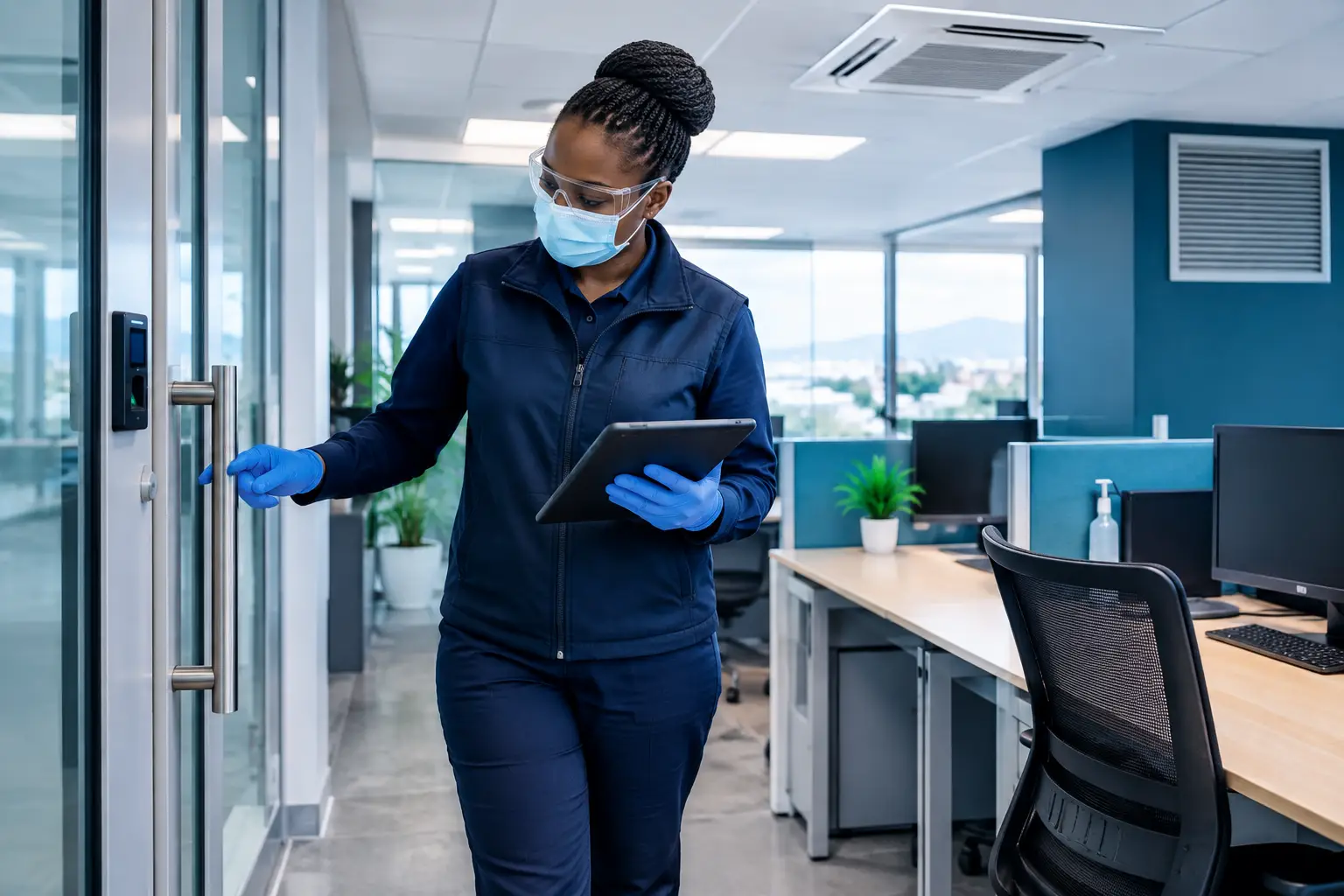
A reception counter may be cleaned thoroughly at 06:00, then handled by staff, visitors, contractors and delivery teams before the morning peak has passed. That operational reality sits at the centre of touchpoint protection versus surface disinfection. Both have a role in hygiene planning, but they are not the same intervention and should not be specified as though they are.
For facilities managers, the question is not which approach is universally better. It is which control is needed, on which surface, in which zone, and how it will work alongside routine cleaning, hand hygiene, ventilation maintenance and site operations. A well-designed programme treats these as connected controls rather than competing services.
What surface disinfection is designed to do
Surface disinfection is an event-based process. A suitable disinfectant is applied to a cleaned surface according to its product instructions, including the required contact time and compatibility requirements. Its purpose is to reduce contamination present on that surface at the point of treatment.
This makes disinfection particularly relevant after a known contamination event, during scheduled hygiene routines, between users where procedures require it, or in spaces with elevated handling volumes. It is an essential operational discipline in many healthcare, hospitality, food-service, transport and commercial settings.
Its limitation is practical rather than conceptual: surfaces do not remain untouched after treatment. Door hardware, lift buttons, handrails, payment terminals, shared controls and washroom fittings can quickly re-enter circulation. The quality of the outcome also depends on preparation, access, coverage, contact time, operator practice and whether the product is appropriate for the material.
Disinfection must therefore be repeatable and documented where the facility requires it. It is not a once-off answer to ongoing touchpoint exposure.
What touchpoint protection adds
Touchpoint protection generally refers to the controlled application of an antimicrobial treatment to selected high-contact surfaces as part of an ongoing hygiene programme. Rather than replacing cleaning or periodic disinfection, it is intended to add a managed protective layer across the physical points people repeatedly share.
The emphasis is on surface selection and application control. A treatment on a rarely used storeroom handle may have limited operational value, while the same approach on reception counters, access-control devices, push plates, shared workstations or vehicle touchpoints may support a more relevant risk-control plan.
The precise performance, suitable materials, application method and maintenance needs depend on the product documentation, the surface condition and the environment. Treatment claims should always be read alongside applicable technical documentation and the scope of supporting tests. A professional programme should also identify surfaces where a treatment may not be appropriate, including sensitive finishes, specialist equipment or areas subject to sector-specific protocols.
The distinction matters because touchpoint protection is often described as if it were simply longer-lasting disinfection. It is better understood as a separate layer of antimicrobial surface management, designed around frequent handling and maintained within a wider hygiene system.
Touchpoint protection versus surface disinfection: the operational difference
The clearest difference is timing. Surface disinfection addresses a treatment moment. Touchpoint protection addresses the period between routine cleaning and disinfection cycles on specified touchpoints. Neither removes the need for the other.
A hospital ward, hotel entrance or airport operations room may need both approaches, but not in identical ways. Routine cleaning removes soil and maintains presentation. Disinfection protocols may apply at defined intervals or following specific events. Targeted touchpoint treatment can then be considered for surfaces that experience continual handling and where compatibility, operational use and programme requirements support it.
There are also differences in deployment. Conventional surface disinfection is often performed manually, surface by surface. Touchpoint protection may involve targeted manual application, controlled dispersal methods or a combination of techniques depending on the site. The method should follow the environment, not a generic checklist.
That distinction is especially relevant in large facilities. A cleaning team can see most reception surfaces, but not every shared point within a service corridor, staff entrance, fleet cab or plant room. Good protection planning begins by mapping how people, equipment and air move through the building.
Start with the routes contamination can take
High-touch surfaces are only one pathway. Contamination risk is shaped by occupancy, movement patterns, cleaning schedules, ventilation routes, zone pressures, equipment sharing and the condition of the building itself. A programme that focuses only on visible surfaces can miss the operational links between them.
At Zoonex Systems, this is approached through four connected stages: assess, disperse, distribute and maintain.
Assess the facility before choosing the method
Assessment identifies the spaces that matter most: public interfaces, staff circulation routes, high-traffic zones, shared equipment, vehicle interiors and operational back-of-house areas. It also considers surface materials, airflow pathways, access restrictions, occupancy patterns and the periods when treatment can be carried out without interrupting the facility.
For example, a hospitality property may prioritise front-of-house touchpoints, guest circulation and service areas. A livestock or agricultural operation may focus more heavily on entry controls, shared equipment, vehicle movement and biosecurity zones. The technology may be similar, but the treatment design should not be.
Disperse treatment under controlled conditions
Where appropriate, ultra-low-volume fogging can disperse a treatment through defined spaces. This is not a substitute for cleaning or for targeted surface work. It is a controlled application method that may help reach complex spaces, depending on the treatment plan, product instructions, ventilation conditions and operational constraints.
Fogging should be planned and carried out by trained professionals. Facilities need clear arrangements for area preparation, occupancy, equipment protection, ventilation management and re-entry requirements in line with the relevant product documentation and site procedures.
Distribute through the pathways that matter
Distribution means directing treatment to the areas that shape day-to-day exposure: ventilation pathways, high-touch surfaces, shared assets and high-traffic operational zones. This is where an engineered approach differs from a broad, once-off spray.
In an office building, the focus may include reception interfaces, lift areas, meeting-room controls and shared amenities. In a fleet environment, it may include cabs, handles, dispatch points and common equipment. In healthcare or aviation settings, access rules, material compatibility and critical operational uptime demand tighter coordination with site teams.
Maintain the programme as conditions change
A treatment programme needs maintenance because the facility changes. Surface wear, cleaning chemicals, refurbishment, altered occupancy, seasonal demand and changes in workflow can all affect the original treatment plan.
Managed maintenance provides an opportunity to review treatment zones, confirm practical access, record completed work and adjust the programme where conditions have shifted. It also keeps antimicrobial treatment connected to routine cleaning schedules and facilities management rather than leaving it as an isolated project.
Choosing the right balance for your site
The right balance depends on the environment. A small office with stable occupancy may need a focused approach to common touchpoints and cleaning coordination. A busy hospital, airport terminal, food-service operation or commercial property may require multiple treatment pathways, carefully phased around public access and continuity requirements.
The useful question is not, “Do we need disinfection or protection?” It is, “Where are our highest-contact and highest-consequence pathways, and which controls can we operate consistently?” A practical answer may include routine cleaning, scheduled disinfection, targeted touchpoint treatment, ventilation-pathway management and documented follow-up.
Procurement decisions should also account for material compatibility, site access, downtime, reporting requirements and the capability of the provider to work around live operations. A treatment that appears straightforward on paper can become unsuitable if it disrupts clinical activity, guest service, production schedules or aircraft turnaround.
Protection that fits the operation
Touchpoint protection and surface disinfection serve different purposes, but their value increases when they are planned as part of one system. Cleaning teams maintain surfaces. Disinfection responds through defined procedures. Targeted antimicrobial treatment can support the shared points and pathways that remain under constant operational pressure.
The most useful hygiene programme is not the one with the longest checklist. It is the one designed around how the facility actually operates, then maintained with enough discipline to keep pace with it.
