
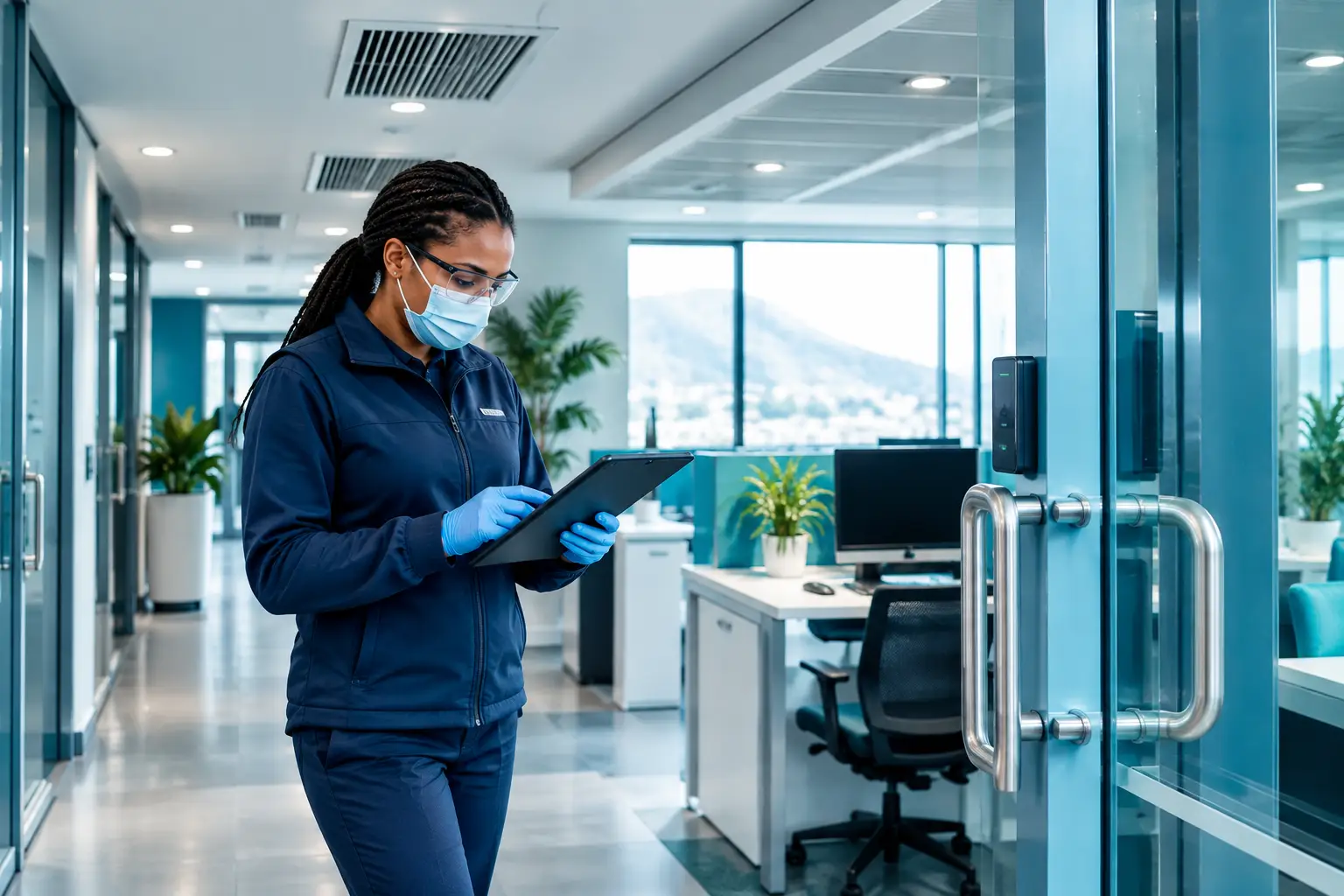
A cleaner may disinfect the obvious touchpoints at the start of a shift, yet a facility’s contamination risk is shaped by far more than door handles. The practical question is which surfaces need antimicrobial coatings when people, equipment, airflow and daily operations continually intersect. The answer is not every surface. It is the surfaces that form part of a facility’s real contamination pathways and where treatment can support, rather than replace, established cleaning and hygiene controls.
For facilities managers and operational teams, the objective is to direct protection where it is most useful: frequent contact points, shared equipment, high-traffic areas and surfaces influenced by ventilation or repeated handling. This requires a site-specific assessment, not a generic checklist.
Which surfaces need antimicrobial coatings first?
Prioritisation should begin with exposure, contact frequency and operational consequence. A surface that is touched by hundreds of people a day deserves closer attention than a seldom-used wall panel. Equally, a low-touch surface within a tightly controlled clinical, food-service, aviation or biosecurity workflow may be operationally significant if it is repeatedly handled by staff, tools or materials.
The most suitable candidates are generally durable, non-porous or sealed surfaces that can be professionally prepared and treated in line with the applicable product documentation. Condition matters. Damaged coatings, heavy soil, loose paint, corrosion and incompatible finishes can affect treatment performance and should be identified before application.
High-touch shared touchpoints
These are often the first surfaces considered because they sit directly within human movement routes. Door and cupboard handles, push plates, lift buttons, handrails, reception counters, payment terminals, access-control readers and shared keyboards are typical examples.
In a commercial building, the lift lobby, reception desk and meeting-room entrance can create a chain of repeated contact throughout the day. In a hospital or care environment, bed-space touchpoints, workstations and staff circulation routes may require a more detailed review of cleaning protocols, material compatibility and clinical operating constraints. The aim is not simply to treat visible contact points, but to understand how people move between them.
Shared tools, equipment and operational controls
Equipment surfaces often matter as much as public touchpoints. Consider control panels, machine interfaces, radio handsets, scanners, trolleys, tool handles, dispatch desks, printer controls and vehicle cabin touchpoints. These surfaces move between shifts, teams and zones, making them a practical part of a wider hygiene plan.
Treatment decisions should account for the equipment manufacturer’s guidance and the sensitivity of the item. Screens, medical equipment, food-contact areas, animal-contact areas and specialised electronics need careful assessment. Antimicrobial surface application is not a licence to treat any material without verification of suitability.
High-traffic surfaces in public and staff areas
High-footfall facilities have surfaces that experience constant contact even when they are not traditionally labelled as touchpoints. Service counters, dining tables, chair arms, restroom fixtures, locker-room benches, vending interfaces and communal break-room surfaces may all be relevant.
In hospitality, this may mean assessing the guest journey from entrance to room, restaurant and lift. In offices, it may mean following the movement between security access, shared workspaces, kitchens and washrooms. In transport or fleet operations, it can include driver cabins, passenger areas, loading controls and dispatch points.
The important distinction is between high traffic and high risk. A busy corridor floor, for example, may be a cleaning priority but not necessarily an appropriate target for a surface coating programme. The material, cleaning regime, wear rate and intended treatment outcome all need to be considered.
Do ventilation-linked surfaces need antimicrobial coatings?
Ventilation pathways deserve attention because protection needs to move through the building in a controlled way. Airflow does not make every surface a treatment target, but it can influence where particles settle, where moisture accumulates and which zones are connected by air movement.
Relevant areas may include accessible ventilation components, return-air zones, grilles, diffusers, plant-room touchpoints and surfaces around heavily used air pathways. These areas should be assessed alongside the condition and maintenance requirements of the HVAC system. Treatment is not a substitute for filter changes, coil cleaning, drainage management or ventilation maintenance.
For Zoonex Systems, this is the practical difference between a surface-only response and one system with multiple protection pathways. Treatment design considers occupancy, airflow direction, access limitations and the way people and equipment pass through the site. In some environments, targeted surface application can be supported by carefully planned dispersal and distribution methods. In others, physical access, operational sensitivity or material type may rule a surface out.
Areas that require a more cautious decision
Not every surface benefits from coating, and a disciplined programme should clearly define exclusions. Highly porous, unstable or deteriorated materials may be unsuitable. So may surfaces that receive aggressive abrasion, frequent refinishing or chemical cleaning that could reduce treatment durability.
There are also operational exclusions. Food-contact surfaces, medical devices, skin-contact items, animal-contact surfaces and sensitive equipment should only be considered where the relevant product documentation, application protocol and site requirements support that use. A treatment provider should not make assumptions based on visual similarity alone.
Surfaces that are already easy to clean, infrequently touched and outside meaningful contamination pathways may not warrant treatment. Directing budget and operational time towards critical areas is usually more effective than applying a uniform coating across an entire facility.
Build the decision around the environment
A sound antimicrobial programme follows the physical environment rather than a generic room-by-room checklist. The process can be organised into four connected stages: assess, disperse, distribute and maintain.
Assess
The assessment maps the facility’s people flows, touchpoints, equipment use, surface materials, airflow routes and operating restrictions. It should also review existing cleaning methods, access windows and areas where treatment could interfere with normal operations.
A restaurant kitchen, an airport departure area and a livestock facility may all have shared touchpoints, but their workflows, materials and control measures are fundamentally different. The assessment defines the treatment zones accordingly.
Disperse and distribute
Once the appropriate surfaces and spaces are identified, the treatment method must suit the environment. Targeted application is appropriate for many touchpoints and equipment exteriors. Where a wider area needs controlled coverage, professionally managed ultra-low-volume fogging may form part of the programme, subject to the product instructions, ventilation arrangements, occupancy controls and site-specific safety procedures.
Distribution is not the same as indiscriminate spraying. It is a controlled process designed around access, surface compatibility, airflow and the spaces that require coverage. Cleaning and preparation remain essential because treatment should be applied to surfaces in a condition suitable for bonding.
Maintain
Antimicrobial treatment works best as part of an ongoing managed routine. Routine cleaning, disinfection where required, hand hygiene, waste management and HVAC maintenance remain essential controls. The maintenance stage reviews treated zones, operational changes, wear patterns and the continuing suitability of the plan.
This matters when a facility changes its layout, occupancy or operating hours. A reception desk may become a visitor check-in point; a storeroom may become a shared dispatch hub; a new ventilation arrangement may change airflow between spaces. Protection should be reviewed as the environment changes.
Questions to ask before specifying treatment
Facility decision-makers can improve the quality of a treatment plan by asking a few direct questions. Which surfaces are touched most often across a typical shift? Which equipment moves between people or zones? Where do visitors, staff, materials and vehicles converge? Which ventilation routes connect occupied areas? Which materials and operational restrictions limit treatment options?
The answers produce a practical map of priorities. They also prevent a common mistake: treating surfaces because they are visible rather than because they are relevant to the facility’s actual exposure pathways.
Technical claims, intended uses and performance expectations should always be read alongside applicable product documentation, test scope and the conditions of the site. A credible programme makes its assumptions clear and adapts to the environment it is protecting.
The best place to start is not with a product or a spray schedule. Start by tracing how people, air and equipment move through the facility. That is where a targeted antimicrobial strategy becomes an operational control rather than another item on a cleaning checklist.
